Labels

accountability agency alcoholism Alisdair MacIntyre Anglican attitudes Anglican communion appreciation approach attitudes audience bad situations Bible binge drinking blindness call Calvin campaigning change chaos Christian discipleship Christmas Church church structures coincidence colonialism committees Communion communities community Congregationalism congregations consumption; conversion councils creation crossing culture curiosity customers debate debt democracy depression Design Argument desire discrimination dissenting diversity doctorates doctors dominance drinking problem Easter ecumenics Ecumenism elderly elements Enlightenment environment; fairness episcopal churches eternal life ethics evangelism evolution excess Facebook faith faithful fencing the table finance fishing forgiveness fowler fraud Free Churches freedom friendly full time gathered church generosity generous gift or goal God gratitude greetings growth heaven history holy holy spirit humanity Humpty Dumpty Hunter hypocrisy integration Internet invitation Jesus Army joining Joy laity Liturgy local congregations love MaM mental health merging misrepresentation mission my experience offices of the church oil open communion outreach p-values pacifism part time passion paths Paul pen names power preparedness Presbyterian Blue Presbyterianism procedures. progress proxies publishing culture purpose radical welcome rant Reformed tradition refugees support regression to the mean relationships replicability respect response responsibility ressurection role Ruth and Naomi savouring Scottish Congregational and United Reformed College Scottish heritage security self esteem situatedness snow Society for Liturgical Studies soldiers spiralling inwards statistics student fees subordinate standards substantial agreement suffering superhuman symbolism symbols synods tax tee total tension the way of the cross theologians theologians in residence thesis time triedness United Reformed Church unity Universities urban priority areas URC vocation vulnerablility Wardlaw weakness welcome welcoming young or old

Wednesday, July 4, 2012

Standards, we have got to have Standards

All right the title is jokey, the thing is the Reformed tradition has subordinate standards. Now don't go looking in the Westminster Confession, or Belgic or the Statement of Nature, Faith and Order of the United Reformed Church for statements about Subordinate Standards, you won't find any. The simple reason is this is self referential these are the subordinate standards. That means for all URCs that the principle Subordinate Standard for us is the Statement of Nature, Faith and Order of the United Reformed Church. So saying we don't have standards is a bit stupid!

There is one thing every one should spot I have so far and will continue to do so, use the term Subordinate Standards. They are Subordinate to scripture. The Protestant shout of "Sola Scriptura" means that practically they never ever have been the final statement on the faith. Doctrine can and is Reformed in order to bring it better in line with Scripture. This is alive and kicking in Reformed Churches. I can remember being asked how a hymn of Kathy Galloways could get into Church of Scotland hymn book where it would struggle with its feminist images into an Anglican one. The answer was simple, the images Kathy used were Biblical, therefore the question was not "Are these images feminist?" but "Are these images Biblical?" and if they are then they trump all questions about whether things were feminist or not. Many Subordinate Statements say exactly that.

Secondly Subordinate Standards are about where the faith has been. Have a look at Reformed Presbytery of North America's list and really go down them. You will find an odd bunch of documents. There are the standards such as: the Apostles Creed and the Westminster Confession, but then look what else is there like: Metrical Psalms and the Acts of General Assembly of the Church of Scotland betweeh specific dates! This does not look to me like a group trying to specify Doctrine it looks far more like a list of documents they tell where the group has come from. To ask who we are is nearly always to ask who we have been.

The picture I tend to come back to is of cairns, they normally come from places where the originating group for some reasons feels that it is a good idea to make a statement about how they see the faith. The reasons can be various; I am almost certain that the Congregationalists insisted on one when the URC was formed. They did not want any pesky Unitarians getting their hands on any property of the new united church and therefore having a statement was essential (the Unitarians won't have a statement because that might meanthose troublesome Congregationalist getting their hands on the property). I think it is instructive that the requirement in the United Church of Canada to become a member is that you assent to belief in the Trinity (not the incarnation or ressurection) and this was insisted on by Congregationalists. The memories of fights in church history die hard. However it has to be said that fresh statements at the creation of a merged denomination are common. They equally occur at times of crisis, points of turmoil and not always theological, quite a few of them are political. However most of the time we plod along with those we have got and don't pay much heed to getting new ones.
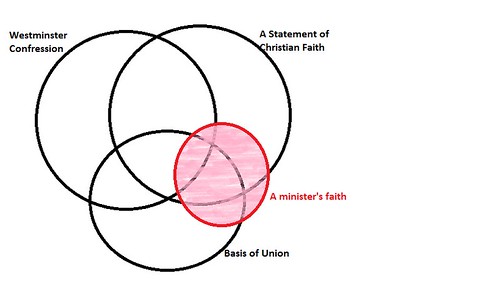
URC approach to "Substantial Agreement"
A while ago I drew two pictures of what we would mean if we required a ministers faith to be in substantial agreement with the subordinate standards. I suggested the URC's approach was like the diagram shown here. I would suspect quite a overlap with the Basis of Union, maybe with quite a bit of agnosticism about parts of it, with other bits being inconcurrence with other Subordinate Standards which we accept. In other words the tradition is defined by having a broad scope with many overlapping subordinate standards and the requirement is that the faith falls mainly within those parameters. It does not mean that all ministers sign up to the same things exactly. Indeed although I have shown three here, there are at least another six named subordinate standards. I defy anyone to know them well enough that they can recall them at an instance and say what they agree and disagree with them let alone accept them all. Then there are the ones we don't name but are included as "of the tradition" e.g. the Scots Confession. However what status is John Robinsons address to the Pilgrim Fathers at Plymouth.  You won't find it on the internet, I might put it up at some stage if I get hold of it, but the paraphrase in the form of We limit not the Truth of God (ignore the tune) is widely sung in the URC and I have heard quoted in theological debate. There is thus a deliberate ambiguity.

Yes I use the subordinate standards, they have been an important vehicle of my initiation into Reformed Theology, but I do not use them in a sort of lets try to believe twenty impossible things before breakfast style. I usually read them through quite quickly the first time, to try to get a feel of them, what is important and how they stand. Then and this is an ongoing process I turn to bits I see as significant and try and work out why. It maybe I disagree with them, in which case I need to work out why, or it might be a phrase gives me cause for reflection, time to look deeper at other understandings. So Subordinate standards are there to say where we have been, not to determine who we are. Remember "Those who cannot remember the past are condemned to repeat it" (George Sanayana) so we need methods of remembering where we have been and knowing why we have travelled to where we are.

Saturday, June 2, 2012

When two traditions collide

In 1972 the URC came into being and two denominational traditions collided. There are problems today that are caused not by the positions regarding wider traditions, these were both traditions dominated by the Reformed Tradition, but by the fact that the two traditions did not bother to find out how the other tradition worked, the Presbyterian assumed that with these sort of half toned Congregationalists they would find it easy to dominate, the Congregationalists assumed that they would continue doing things as they always did with a few adjustments for Presbyterians as they had done before. The Presbyterians assumed there was a meeting two dissenting traditions of which theirs was superior  because it was articulated. The Congregationalists just assumed the way they did things was the way it was to be done noy because it was Congregational but because that was how it was.

The mistake was made in thinking that within English Congretationalism there was a named tradition that in some way is comparable to the Presbyterian tradition of the Presbyterian Church of England. This Presbyterian tradition is that of a clear dissenting tradition that stands against the mainstream. It says "We do this BECAUSE we are PRESBYTERIAN". It is clear and defined. English Congregationalism on the whole found no need for such a tradition. Indeed may have found problems with having it. Rather with respect to tradition it relates as a dominant discourse, the tradition has no name (or rarely is named) but is referenced by how "We do it".

I suspect that this has several roots. Firstly the obvious one, the tradition is not a single strand but a loosely woven rope of many strands that are not always compatible. It is true that the Reformed strand is the core one but there are plenty of other bits. It has to be seen as an grouping that specialises in bringing the disparate together. What is more with the Independent part, for most congregations "the tradition" is primarily the tradition of that congregation and only secondarily draws on the wider experience of other congregations and the wider church. When you talk about the wider context few members have any interest. Thus there is a need to have a way of talking and holding things together without setting people's backs up. Names tend to carry baggage with them, so it is convenient if their is no name for anyone to object to.

Secondly in England there was an indicator name change I suspect at the end of the nineteenth Century. Before that all Congregational churches tended to be called Independent and Congregational used only after then. Traditions are conservative by nature, I suspect that there is a strong streek of people who still think of themselves as going to the Independent Chapel despite this. To add to this the change seems to coincide with the NonConformist Ascendancy in Late Victorian times. There were places in England where Congregationalism was the dominant tradition, so naturally it took the dominant form.

The result is that former English Congregationalists are not concious of their Congregational heritage but they are secure in it, assuming it is the way things ought to be done by any rational person. They have not had a name and feel no need for a name. For them the question was how the Presbyterians will alter the way we do things. It is a tradition based around absorbing not fracturing.

The former Presbyterians, as do former Congregational Church of Scotland, (I have not idea what former Churches of Christ do) find that what happens is that instead of their nice named dissenting tradition, they are faced with a nameless mesh of ideas that somehow resists their attempts to say what it should be like.  What is worse it uses the first person plural "We" of itself so your choice is to join it or dissent from belonging. This is not tradition as they know it, yet it assumes the dominant position.