There has been a blog discussed on facebook suggesting that it might be a good idea for congregations to employ theologians. The blog was taken down, but I did find this article on Christian Century describing Theologians in Residence. Now before we go any further let me be clear I have a vested interest. I am a lay person just about to complete my doctoral studies in theology. So it looks as if the church is about to create positions for people like me. O this is America so it may come about in the UK about the time I am due to retire, so I am not holding my breath.
However I want to question the whole idea, but not for the usual arguments. The usual two are as follows. Firstly that all Christians (Muslims, Jews and Atheist as well) are theologians. That is they have a conceptual frame work that works around the idea of God (even if in the case of most* Atheists this is God's non-existence). I am quite happy with that, I would encourage such people to work at and thus clarify their understanding as much as possible. Trying to speak honestly about the nature of God is in my opinion a good thing. The second is that the cleric/minister/priest is a theologian in residence, and to an extent they are right. That is the cleric/minister/priest will have spent time in theological education, should have an understanding of the wider debates within Christianity and has a role in helping members of the local church grow in their understanding as well as action, character and devotion to the faith.
However "the Theologian" is not new, not within Reformed circles, it goes right back to at least John Calvin. His five fold ministry was Apostles, Prophet, Minister, Doctor and Elder (yes no Deacon although the role is explained in the Institutes). What I am interested in is the office called "Doctor". This is what I take a theologian of the Church to be. One thing should be immediately clear, those offices are in order of seniority, "Doctor" is lower than "Minister". You technically would expect to be more of them, but there have been fewer recognised. Oddly enough it never go to none but you needed to listen carefully to discover who is Doctor and not a Minister. They also tended to fill roles that looked senior to ministers such as being involved in ministerial training.
Apostles and Prophets arise in time of crisis; the Apostles providing leadership and the Prophets warnings. However on a day to day basis they are not needed. He however then folds them back so that Ministers are the common place equivalent of Apostles and Doctors are thus common or garden prophets. Lets look at the two senior roles in ancient Israel Priest and Prophet. The Apostle would map to priest roughly. In one important aspect at least, the priest was entitled to income for his religious role. This is acknowledged for ministers. The snag for this is that the prophet isn't. If a prophet was a priest then he did get the income as a priest to enable him to fulfil that role but he did not get it for being a prophet. The prophet needed independency to fulfil their role as prophet in ancient Israel. The doctor/theologian needs independency to fulfil their role in the church and the congregation needs an independency from them. A theologian is only as good as the insights that they bring.
So no a theologian in residency is not the way to go. In fact in some ways if a theologian takes such a post then they are compromising their role. They become over reliant on the hand that feeds them and can end up saying what it wants them to say rather than struggling with the word of God.
Remember I said that Doctors of the church should be more numerous than ministers, but few are recognised. They are there, indeed they exist already in every congregation in my experience. They quite possibly have done some extra study, fulfil teaching roles e.g. lay preacher, head of junior church and are known in the congregation for their deep spirituality. They probably make up the core members of your bible study groups. They may or may not be elders and not all elders are Doctors of the Church. Some ministers are, and some are not; just as some priests were prophets and some were not.
*I am aware that there are individuals who would use the badge Atheist, but do not make such a clear statement.
Friday, February 28, 2014


Saturday, September 21, 2013
Pacifist tendencies but.....
I do not call myself a pacifist, my great grandfather was pacifist, he would rather be beaten and his family's income stolen than actual defend himself. That takes guts and strength of will. I am not saying I do not have it, but I do not feel that until there you genuinely know your will. So I would say I have pacifist tendencies, but they have never been tested when it counts.
However, when I hear stories such as American Soldiers on Food Stamps I find myself getting angry. While that anger comes out of my pacifist tendencies, it is not an anger at the soldiers. It is anger at the hypocrisy of a society that can applaud men one minute and yet once they are demobbed will leave them to their plight. The world has not changed much since Rudyard Kipling wrote Tommy.
So let me say this now. I may think it is wrong for a country to ask young men and women to do the tasks that they ask people in the army, navy and airforce. I may think that war is best avoided because of what it will cost and often than cost is born by the most vulnerable. This is not an argument against nuclear war, the number of children who die in conventional warfare is high. Some of the deeds done are horrendous. The US authorised the bombing on maternity hospitals in Africa twenty years ago, so that the regime could not provide better facilities for women than had happened under British colonialism because it was communist. Do not worry the English invented concentration camps during the Boer War. War leads nations to behave in vile ways.
However, it is one thing that says that war is not something we should plan for. It is another thing altogether to hold the soldiers who serve as responsible for these vile things. In many ways they are as much a victim of war as the children who get killed by a stray bullet. We ask of them what we could not do ourselves, what we would not be prepared to do ourselves. In the process of doing so many come back with injuries both physical and mental that makes integrating into normal civilian life difficulty. Indeed there is a sense in which the military having its own code of behaviour can institutionalise soldiers and make their return to civilian life difficult even without a disability.
Now if we ask of people to do this. I know the government does, not me personally, but the government does on our behalf. Then I see as a basic quid pro quo, that we have a responsibility to look after them. In other words,when a young person signs up to join the services the nation takes responsibility for making sure they are cared for, not just while they serve, but for their life. Often that also includes responsibility for the family as well.
So I may not be their out cheering on the soldiers on parade, I may well campaign against various wars and I may even choose not to wear a red poppy. However, I will not be among those who berate soldiers, I will donate to charities that aim to look after them, and if ever there comes the opportunity to vote for better conditions for ex-service men and women, they can count on my vote.
I would rather they were not asked to serve, but given that they are, it is the least we can do.
However, when I hear stories such as American Soldiers on Food Stamps I find myself getting angry. While that anger comes out of my pacifist tendencies, it is not an anger at the soldiers. It is anger at the hypocrisy of a society that can applaud men one minute and yet once they are demobbed will leave them to their plight. The world has not changed much since Rudyard Kipling wrote Tommy.
So let me say this now. I may think it is wrong for a country to ask young men and women to do the tasks that they ask people in the army, navy and airforce. I may think that war is best avoided because of what it will cost and often than cost is born by the most vulnerable. This is not an argument against nuclear war, the number of children who die in conventional warfare is high. Some of the deeds done are horrendous. The US authorised the bombing on maternity hospitals in Africa twenty years ago, so that the regime could not provide better facilities for women than had happened under British colonialism because it was communist. Do not worry the English invented concentration camps during the Boer War. War leads nations to behave in vile ways.
However, it is one thing that says that war is not something we should plan for. It is another thing altogether to hold the soldiers who serve as responsible for these vile things. In many ways they are as much a victim of war as the children who get killed by a stray bullet. We ask of them what we could not do ourselves, what we would not be prepared to do ourselves. In the process of doing so many come back with injuries both physical and mental that makes integrating into normal civilian life difficulty. Indeed there is a sense in which the military having its own code of behaviour can institutionalise soldiers and make their return to civilian life difficult even without a disability.
Now if we ask of people to do this. I know the government does, not me personally, but the government does on our behalf. Then I see as a basic quid pro quo, that we have a responsibility to look after them. In other words,when a young person signs up to join the services the nation takes responsibility for making sure they are cared for, not just while they serve, but for their life. Often that also includes responsibility for the family as well.
So I may not be their out cheering on the soldiers on parade, I may well campaign against various wars and I may even choose not to wear a red poppy. However, I will not be among those who berate soldiers, I will donate to charities that aim to look after them, and if ever there comes the opportunity to vote for better conditions for ex-service men and women, they can count on my vote.
I would rather they were not asked to serve, but given that they are, it is the least we can do.
Friday, June 7, 2013
Why I post pro-refugee, pro-immigration and pro-muliculturalism stuff to Facebook
A while ago a friend posted some anti-asylum stuff to Facebook. Typical right wing hyperbole, the thing was this friend should have known better. The church she goes to supports Sheffield's City of Sanctuary. It was fairly easy to counteract the stuff from the governments own sources! She responded with "at least now we can talk about it".
Well reporting this sort of stuff is not a good idea, arguing nearly always forces people into a more extreme position than they held before. I have known few people rethink positions in arguments unless they started the discussion in an attempt to rethink. So I decided to disengage. I could I suppose have deleted the post from my Facebook stream.
The problem was not that people held it but that I knew she was in contact with a number of people who held much stronger views than me on this and she had not picked it up. So I started to think about it. I decided it was time I put a marker.
Firstly I did not really want to join a campaign, there were plenty very worthwhile ones but I felt that campaigns are often over strident and I wanted to take the pressure off people. I also decided that putting out a lot of statistics and legal stuff was not going to get me anywhere.
Secondly I decided that what I needed to do was to encourage people to see asylum seekers, refugees and immigrants as fellow human beings. That meant seeking out the human interest stories, the people who relate their experience with individuals who can make the day to day reality come to life in this country.
Thirdly my task was to try and get people to think and not to tell them what to do. Doing this meant that I needed to limit the amount of stuff I put on Facebook stream. There is lots of stuff out there, but I wanted not to become a person who only talks about one topic. There had to be other topics in discussion and these had to be non campaign as well. Only when this was part of the mix on my stream would it be effective. This is also why I will post when I sign a petition but I am not going to say to other to do it as well. It is up to you.
I do not know how long I will keep it up, but I do want to try and do it for quite a while.
Well reporting this sort of stuff is not a good idea, arguing nearly always forces people into a more extreme position than they held before. I have known few people rethink positions in arguments unless they started the discussion in an attempt to rethink. So I decided to disengage. I could I suppose have deleted the post from my Facebook stream.
The problem was not that people held it but that I knew she was in contact with a number of people who held much stronger views than me on this and she had not picked it up. So I started to think about it. I decided it was time I put a marker.
Firstly I did not really want to join a campaign, there were plenty very worthwhile ones but I felt that campaigns are often over strident and I wanted to take the pressure off people. I also decided that putting out a lot of statistics and legal stuff was not going to get me anywhere.
Secondly I decided that what I needed to do was to encourage people to see asylum seekers, refugees and immigrants as fellow human beings. That meant seeking out the human interest stories, the people who relate their experience with individuals who can make the day to day reality come to life in this country.
Thirdly my task was to try and get people to think and not to tell them what to do. Doing this meant that I needed to limit the amount of stuff I put on Facebook stream. There is lots of stuff out there, but I wanted not to become a person who only talks about one topic. There had to be other topics in discussion and these had to be non campaign as well. Only when this was part of the mix on my stream would it be effective. This is also why I will post when I sign a petition but I am not going to say to other to do it as well. It is up to you.
I do not know how long I will keep it up, but I do want to try and do it for quite a while.
Sunday, March 31, 2013
Struggling with Easter
I long ago fell out with the liberal Christian group or atheist who want to ask questions about how the resurrection really happened. Whether the talk is of "conjuring tricks with bones", questions of the physicality of the resurrection, body snatching or the idea that some how Christ was in a coma. It is not that I want to argue with them, it just is not a question that I see as answerable or being really of interest. My God is certainly capable of doing it, whether he did or not is lost in the midst of times. What I am struggling with is why he did whatever he did.
First let me be honest where I am coming from. I do not want eternal life, thank you! The idea that my life might end and there be nothing more seems desirable. Indeed so desirable that if I had genuinely believed that was an option I would have been dead over twenty years ago. To me and I suspect some others with mental health problems, the simple act of existing feels wearisome. Do not get me wrong, I can feel joy, can participate in events, join in celebration and enjoy a quiet read. But I know I will come back to reality of me and how tired I am of it. When I am down this tends to sap the energy to do anything. When I am moderate I find silence and low activity levels totally absorbing. When I am up as at present, it acts more as a fantasy.
Now I struggle with Easter in two ways. Firstly the tendency to view it as the "happy ever after" end to the story. In most atonement theories it looks as if Christ's action on Good Friday was enough. The Easter Sunday is an add on that seems to be the implausible ending to make a happy ending. There is one exception and that is the exemplar of God's love theory. The argument would go that Christ went through the worst of human experience, was given the option to not come back and did. When I meet that one, the resurrection to me becomes mind blowing, its just not something I can imagine myself doing. I am not sure that I love anyone enough to be given an out and still come back. It makes no sense and yet in some ways it shows me something I can only just grasp.
However having got that far, I then run into the talk of eternal life. You think this is good news, well to this individual it is not. My personal idea of Hell I suspect is pretty close to a continuation of this life with the daily task of existing. Yet on Easter day I am supposed to get excited about that. Well I am not and no amount of jumping up and down will make it so. Yes I have lost people I care about to death, but I also did not want to hold onto them, keep them here. My Grandparents on my father's side were really quite cross with God for letting them live so long. People walk out of my life for a whole host of reasons and death is only one of them. I have learnt to accept that though they will not be replaced yet I will find new friendships and different ways of living without them.
Here are some things that might just appeal. If the resurrection means that there will be a final reckoning when we will face the total of our lives, when the injustice, cruelty and such will finally be called to account, I can actually see something worthwhile in that. I need to face the hurt and pain I have caused to others, to not do so is to be deluded about who I am. I do not expect it to be pleasant but I do expect the integrity that goes with it to be a good worth savouring.
However there is another thing that I feel that if I could glimpse more than just mentally stretch towards might somehow make it and that is the experience of living a life shaped absolutely by the worship of God. Do not get me wrong I do not mean one where all day every day is a praise service. Our worship of God is wider and deeper than that. I mean one where for a while I am simply caught up in living so as to honour God. To focus not on existing but on the creator. I occasionally get moments of wonder, but the wonder is fleeting and I move on, as if nothing has happened. I want the tensions that seem part of living to be resolved for a short while and somehow they never are. Therefore if somehow I can imagine that eternal life is to be the briefest of flickers in the molten love of God and caught up in the heavenly praise then I begin to find images of eternal life that promise me not the endless dull tiredness but a relief from having to exist.
First let me be honest where I am coming from. I do not want eternal life, thank you! The idea that my life might end and there be nothing more seems desirable. Indeed so desirable that if I had genuinely believed that was an option I would have been dead over twenty years ago. To me and I suspect some others with mental health problems, the simple act of existing feels wearisome. Do not get me wrong, I can feel joy, can participate in events, join in celebration and enjoy a quiet read. But I know I will come back to reality of me and how tired I am of it. When I am down this tends to sap the energy to do anything. When I am moderate I find silence and low activity levels totally absorbing. When I am up as at present, it acts more as a fantasy.
Now I struggle with Easter in two ways. Firstly the tendency to view it as the "happy ever after" end to the story. In most atonement theories it looks as if Christ's action on Good Friday was enough. The Easter Sunday is an add on that seems to be the implausible ending to make a happy ending. There is one exception and that is the exemplar of God's love theory. The argument would go that Christ went through the worst of human experience, was given the option to not come back and did. When I meet that one, the resurrection to me becomes mind blowing, its just not something I can imagine myself doing. I am not sure that I love anyone enough to be given an out and still come back. It makes no sense and yet in some ways it shows me something I can only just grasp.
However having got that far, I then run into the talk of eternal life. You think this is good news, well to this individual it is not. My personal idea of Hell I suspect is pretty close to a continuation of this life with the daily task of existing. Yet on Easter day I am supposed to get excited about that. Well I am not and no amount of jumping up and down will make it so. Yes I have lost people I care about to death, but I also did not want to hold onto them, keep them here. My Grandparents on my father's side were really quite cross with God for letting them live so long. People walk out of my life for a whole host of reasons and death is only one of them. I have learnt to accept that though they will not be replaced yet I will find new friendships and different ways of living without them.
Here are some things that might just appeal. If the resurrection means that there will be a final reckoning when we will face the total of our lives, when the injustice, cruelty and such will finally be called to account, I can actually see something worthwhile in that. I need to face the hurt and pain I have caused to others, to not do so is to be deluded about who I am. I do not expect it to be pleasant but I do expect the integrity that goes with it to be a good worth savouring.
However there is another thing that I feel that if I could glimpse more than just mentally stretch towards might somehow make it and that is the experience of living a life shaped absolutely by the worship of God. Do not get me wrong I do not mean one where all day every day is a praise service. Our worship of God is wider and deeper than that. I mean one where for a while I am simply caught up in living so as to honour God. To focus not on existing but on the creator. I occasionally get moments of wonder, but the wonder is fleeting and I move on, as if nothing has happened. I want the tensions that seem part of living to be resolved for a short while and somehow they never are. Therefore if somehow I can imagine that eternal life is to be the briefest of flickers in the molten love of God and caught up in the heavenly praise then I begin to find images of eternal life that promise me not the endless dull tiredness but a relief from having to exist.
Saturday, February 16, 2013
Two types of Doctorate
I am coming to the conclusion that there are two types of PhD in existence. Let me start with the prompts for this thought. There is Pat Thomas' blog on enjoying academic work and also a post on LinkedIn that suggested that we should no longer have part time PhDs.
I am going to consider two doctoral students. There is on the one hand Bob. Bob is young bright and wants to be an academic, he is interested in his nanotechnology and has got a fully funded PhD in one of the major research teams in the world. As this is a research team, his supervisor has chosen the topic, he works with other researchers and team meetings are an important part of his research. He has presented a couple of papers at conference and has been first author on one and a third author on another paper. He sees research as collaborative but knows that he will have to write up his research though he can expect his supervisor to vet it closely. He works long hours but also is a long distance runner and takes his training quite seriously
Then there is Bill, he is bright, but as he has spent most of his life teaching in variety of schools he is no longer young. Having taken early retirement and come into a legacy, he has decided to follow through on his interest in the establishment of the local schools prior to the education act. Wanting to turn what had been an interest for a number of years into something more formal, he had approached a lecturer at a nearby university who had an interest in the history of education, who had agreed to take him on in a part time basis, having seen some of the writing he had already done for a local history society. Bill is grateful for the access to the library, his supervisors supervision and the occassional chance to meet other people in the area at the occasional seminar. He has paid his own way to one or two conferences and presented a paper there. However he has several articles published of which he is sole author. Bob puts what time he can find into his thesis between looking after his wife who confined to a wheel chair with arthritus.
These are of course fictional and deliberately drawn to be polar opposites. Bob is your quintessential career academic. He is enthused with the ideas of nanotechnology and is happy to be doing research into an area of it. That his supervisor actually decided what his thesis is about, does not really matter too much, he just is excited about studying it. He expects that at least at some stage to work with other resesearch teams and to have to work up the system to become lead researchers. For him the doctorate it just part of his involvement with nanotechnology. He would be unhappy if he did not get a job that allowed him to continue in this area of study. For Bill the opposite is true. If his supervisor started to try to direct him away from the investigation of origins of local schools to something the supervisor was more interested in, then Bill is likely to just walk away. Bill is not wanting the job that comes from having a Doctorate he is wanting the ability to indulge his interest in a topic that enthuses him and is paying for it. Bill is not going to be upset if he does not get a job from his research, partly because he is not at that age and partly because he is acknowledges that that is not why he did this.
The result is that Bob and Bill look at working in academia very differently. For Bob this is his equivalent of a being an elite sportman, it is what he is working for and he darn well hopes to get there. For Bill it would a surprise and a delight that enables him to continue exploring what he is interested in.
Now what I am going to suggest is that Bill will be far more aware of his enjoyment of academia then Bob. Not because Bob is a worse academic, he isn't, indeed the stats show Bob has a much greater potential to be a leader in his field then Bill, but simply because where as for Bob being in academia is something he has striven and worked for; for Bill what has driven him is the curiousity and he finds himself in academia because that is where his curiosity has led him and therefore he receives the environment of academia as gift where as Bob sees it as a goal.
I am going to consider two doctoral students. There is on the one hand Bob. Bob is young bright and wants to be an academic, he is interested in his nanotechnology and has got a fully funded PhD in one of the major research teams in the world. As this is a research team, his supervisor has chosen the topic, he works with other researchers and team meetings are an important part of his research. He has presented a couple of papers at conference and has been first author on one and a third author on another paper. He sees research as collaborative but knows that he will have to write up his research though he can expect his supervisor to vet it closely. He works long hours but also is a long distance runner and takes his training quite seriously
Then there is Bill, he is bright, but as he has spent most of his life teaching in variety of schools he is no longer young. Having taken early retirement and come into a legacy, he has decided to follow through on his interest in the establishment of the local schools prior to the education act. Wanting to turn what had been an interest for a number of years into something more formal, he had approached a lecturer at a nearby university who had an interest in the history of education, who had agreed to take him on in a part time basis, having seen some of the writing he had already done for a local history society. Bill is grateful for the access to the library, his supervisors supervision and the occassional chance to meet other people in the area at the occasional seminar. He has paid his own way to one or two conferences and presented a paper there. However he has several articles published of which he is sole author. Bob puts what time he can find into his thesis between looking after his wife who confined to a wheel chair with arthritus.
These are of course fictional and deliberately drawn to be polar opposites. Bob is your quintessential career academic. He is enthused with the ideas of nanotechnology and is happy to be doing research into an area of it. That his supervisor actually decided what his thesis is about, does not really matter too much, he just is excited about studying it. He expects that at least at some stage to work with other resesearch teams and to have to work up the system to become lead researchers. For him the doctorate it just part of his involvement with nanotechnology. He would be unhappy if he did not get a job that allowed him to continue in this area of study. For Bill the opposite is true. If his supervisor started to try to direct him away from the investigation of origins of local schools to something the supervisor was more interested in, then Bill is likely to just walk away. Bill is not wanting the job that comes from having a Doctorate he is wanting the ability to indulge his interest in a topic that enthuses him and is paying for it. Bill is not going to be upset if he does not get a job from his research, partly because he is not at that age and partly because he is acknowledges that that is not why he did this.
The result is that Bob and Bill look at working in academia very differently. For Bob this is his equivalent of a being an elite sportman, it is what he is working for and he darn well hopes to get there. For Bill it would a surprise and a delight that enables him to continue exploring what he is interested in.
Now what I am going to suggest is that Bill will be far more aware of his enjoyment of academia then Bob. Not because Bob is a worse academic, he isn't, indeed the stats show Bob has a much greater potential to be a leader in his field then Bill, but simply because where as for Bob being in academia is something he has striven and worked for; for Bill what has driven him is the curiousity and he finds himself in academia because that is where his curiosity has led him and therefore he receives the environment of academia as gift where as Bob sees it as a goal.
Tuesday, January 8, 2013
The debate over the colour of church padlocks
This is a story I have told before and no doubt will tell again elsewhere but it shows the way something trivial can have layers of meaning.
Many, moons ago, I was sitting in a classroom in Westminster college when the tutor (not a member of Westminster staff) opinined that the reason we got heated debates over the colour of church padlocks is that people felt that they were qualified to have an opinion about that.
I came back and happened to recount the story to my minister. She then recalled a heated church meeting of several years ago where one senior member got up to complain that the guttering was not painted Presbyterian Blue any more. In other words the choice of colour of padlock on the church gate might well be a sign of identity.
However what colour was Presbyterian blue, well as far as I can tell it is a light shade of Royal Blue. Well it is a highly political statement
Now lets start un picking that. Presbyterian blue symbolises both loyalty to the Protestant monarchy or maybe both monarchist and protestant.If we take the Whig reference, where they seem to have stuck with the orange or buff with their golden bird (hang on is that background Presbyterian Blue?) yet non-conformity particularly Presbyterianism and Congregationalism have stuck with the blue.
In a very short while I have taken you a long way from the debate over padlocks. Does the colour matter? If so what level of symbolism matters?
Many, moons ago, I was sitting in a classroom in Westminster college when the tutor (not a member of Westminster staff) opinined that the reason we got heated debates over the colour of church padlocks is that people felt that they were qualified to have an opinion about that.
I came back and happened to recount the story to my minister. She then recalled a heated church meeting of several years ago where one senior member got up to complain that the guttering was not painted Presbyterian Blue any more. In other words the choice of colour of padlock on the church gate might well be a sign of identity.
However what colour was Presbyterian blue, well as far as I can tell it is a light shade of Royal Blue. Well it is a highly political statement
The blue and buff of the whigs of the present day probably derive their origin from the Presbtyerian blue and orange favours, which were worn at the time of the Revolution to commemorate the deliverance by the wisdom and valour of the Prince of OrangeThis is a foot note from Hudibras: a poem, Volume 2 By Samuel Butler, Zachary Grey, John Heaviside Clar.
Now lets start un picking that. Presbyterian blue symbolises both loyalty to the Protestant monarchy or maybe both monarchist and protestant.If we take the Whig reference, where they seem to have stuck with the orange or buff with their golden bird (hang on is that background Presbyterian Blue?) yet non-conformity particularly Presbyterianism and Congregationalism have stuck with the blue.
In a very short while I have taken you a long way from the debate over padlocks. Does the colour matter? If so what level of symbolism matters?
Monday, December 10, 2012
The misplaced symbol and liturgical practice
I in said "I it use a word tone what a scornful, when Humpty just less choose means neither more nor Dumpty"That does not make much sense does it.You might just realise that it is the quote from Alice through the looking glass
"When I use a word," Humpty Dumpty said in a rather a scornful tone,"it means just what I choose it to mean --- neither more nor less."but it hardly says that because the words are deliberately put in the wrong order. You see Humpty Dumpty is wrong, words are symbols and symbols get their meaning through use and relationship. That is how people use words and the various connections, rules and associations that we apply to the use of the word. Syntax and grammar are just two of these relationships.
If words are taken out of their relationship their meanings change:
A-'s a giggle nowAccording to Homi Bhabha this is taken from Adil Jussawalla's poem Missing Person. What Bhabha points out is the use of "अ" which is the first letter of the Hindi alphabet and takes the sound "er". It 'misplacement' make the monoglot English speaker, such as me, stumble as we do not have the skills for interpreting the symbol. Yet oddly in that stumbling might make the intended sound, showing his poetic skill. The symbol used where it is not expected causes a tension within the poem. It carries meaning but takes it at the cost of being unintelligible.
bit on it Osiris, Ra.
An अ an er.. a cough
once spoking your valleys with light.
On it St Pancras station,
the Indian and African railways.
That's why you learn it today.
...
Get back to your language
If you have travelled with me so far, you may at least be persuaded that symbols at least in part take their meaning from their use and relationships, if they are placed elsewhere they change their meaning but that change comes at a price and that price can well be incomprehension.
Let me now turn to liturgical practice. It is accepted that all acts of worship include the handling of symbols. At the most basic level because all human culture involves the handling of symbols. That meanst that within the worship setting there is a system developed of handling symbols and in doing this the symbols gain specific meanings. Quite often the meanings are left unspoken or explained and it is assumed an initiate can read them.
Now in the current ecumenical age it is often assumed that symbols may be lifted from one rite and placed into another without altered meaning or even with an alternative meaning.
It should be clear from what I have written above that actually such behaviour is an act of colonialism. That is the persons so doing it, are trying to appropriate that which belongs to a symbolic system not their own and to incorporate it into their own. To a certain extent this has always gone on and the CofE as the most powerful colonizer in the UK is a past master at it. However just because the URC is a bit player does not excuse it when it does similar. I am not going to say never but the use of a symbol from another symbolic tradition needs to be done with care. There are dangers.
Firstly the transplants tend to act rather as the अ above. That is they take on a similtude of their intension rather than the actuality. Sometimes they can even mislead. My colleague at work, someone who as far as I know is a thorough going secularist and most of the time is not bothered by religion, for a few weeks in his late twenties took to wearing a cross. He wore it upside down. I decided this could not go uncommented on so I asked him what his devotion to St Peter was. So you need to be careful about the relationship between what the symbol means in its original symbolic system and what you intend it to mean.
Secondly the introduction of a new symbol into an already existent system has knock on effects. That is they have a tendency to smuggle in more than the smuggler intends. The result is a rearrangement in the meanings associated with the other symbols within the original system. The liturgical year is only brought into non-Conformist worship at the expense of the careful exegetical preaching through entire books that formed one of the planks that made us whole Bible people. That was not the intention of the innovators, they wanted to get away from preaching on a passage of your choice but now huge chunks of the Bible are rarely preached on.
Therefore I would suggest that care was taken when you move a symbol from one symbolic system to another. The movement should not be in such a way that it denigrates the integrity of the original symbolic system; the movement should be careful that the symbol works in an effective way within the system into which it is placed.
We are humans, we live within a culture and are bounded by that culture. Humpty Dumpty is wrong, because our use of symbols can never solely be what we intend them to be, they will always Janus like look back towards the previous uses and on towards the future uses. The meaning never fully resolved within the instance they are performed.
Sunday, November 25, 2012
Reformed Democratic Pneumatology
I started this a while ago, but with the Church of England debate and the increased discussion on how church councils should be conducted. What I am doing is outlining what I see as the important balance within the theology of discernment carried out in councils of the church from the English Reformed Perspective and the disciplines that are needed by members for that to function.
Firstly let me say that URC like the Anglicans have a lot of procedures which on the surface appear to be democratic but can often lead to things that people do not see as democratic outcomes. The grumbles within the URC tend to focus particularly on the ability of the major councils (General Assembly and Synod) to engage with the local congregations. Like the Anglican church they are often seen as the provenance of the self selecting few.
Long words I am afraid, but I think this needs to be said as the URC is going once again through the "we are governed by the people" "no we are not we are governed by the Holy Spirit". The correct answer it of course "Yes", it is not an either or situation. Firstly there are some quite specific things that English Reformed Church has adopted:
There is a problem, we all are very well aware of the debate and voting meeting of a secular business meeting and to an outsider that is what the form of our meetings take.
I am going to suggest we need to think about how we conduct meetings and the disciplines with which we conduct them. I am not going to suggest major constitutional changes.
First of all we need at all meetings at all times to practice hospitality. No I do not mean provide food, I mean the practices that make a good host. One is to try an anticipate the needs of others, these can be simple as using a loop system so those who struggle with hearing can hear. That however means every person who speaks in a meeting must speak with a microphone. Therefore if somebody can not easily get to a microphone you need to find ways of getting to the microphone to them. It means that we should all be patient with those who struggle with words and we should all be careful not to bore others.
However I also note that often people when they want a council to change want it to change in ways that would favour them. Everyone is different and therefore have different preferences over how the meeting should be run. Not everyone is happy standing up and speaking in a meeting. Not everyone is happy working in small groups and feeding back. Not everyone likes to write up on notice boards. Some individuals like silence to think things through others like the cut and thrust of a debate. Some people like formal approaches others prefer informality. Some like to have information in advance and will read and digest it, others much prefer that everything is presented at the meeting. Some like the routine to be the same each time and some find variety to be more engaging. As we choose approaches so we also choose the people who are most likely to contribute. There is no easy solution but we need to be aware that the way we ask people to participate alters who is comfy participating. God has not given a standard form that must be followed but we do need to be aware if people are feeling that uncomfortable that they are self excluding from the debate. In such situations ways do need to be sort to include them without excluding others.
Another important guideline is to keep procedures simple. That is that most people will be more content and feel more happy about contributing if they know what is going on. Having complicated methods of voting and such just makes most people insecure and edgy. Also realise that people often like to suss out how something works before they try using it. Some people will always be flustered if asked to do something for the first time. If you must have complex ways of doing things then make sure that you find at least three different ways of presenting it so people have a good chance to get hold of what is happening. That does not mean three contradictory sets of instructions. It does mean something like:
The final one is that we should spend time and energy encouraging people to listen. The real skill of participating in a church council is not speaking but in listening, in hearing not just what is said on the surface but what is also being said below the surface. In some sense this is listening for the spirit, but it is also listening to your inner voice, seeing the way that you interpret what someone else says. Are there words you hear particularly well and also words you miss? Does it matter who says something? It is not easy to listen at that depth, I am not claiming that I do it all the time, but if we are truly to do the discernment it is what is needed. It is easier to listen at this level in a small meeting than a large one. Perhaps a good reason for having smaller meeting in which people can practice doing this. Without those among us who listen at this level we are not really in a position to weigh the material and to progress the discernment. This of course slows things down and in our quick fix society this listening is counter cultural.
Given this as you might expect I do not see form as an essential for discernment, we are human all human form will fall short of the divine, God still works through it. Nor do I think we should expect the outcome to be the same regardless of situation. Because it is not a voting democracy but an act of discernment, I am quite happy with restricting the meeting to those present, with votes that are not simple majorities and with consensus procedures if used appropriately. Votes are in the end only as binding as we make them in this procedure.
If I am honest I think the one essential is that we stop assuming that members will just pick things up as they go along and start actively trying to engage members in doing this sort of discernment and understanding what they are doing in church councils is this. That may require changes in approach, teaching within and outside of church councils and also a lot of careful chairing. It certainly will not make councils quicker initially but I suspect that until we do, people will continue to gripe about them.
Firstly let me say that URC like the Anglicans have a lot of procedures which on the surface appear to be democratic but can often lead to things that people do not see as democratic outcomes. The grumbles within the URC tend to focus particularly on the ability of the major councils (General Assembly and Synod) to engage with the local congregations. Like the Anglican church they are often seen as the provenance of the self selecting few.
Long words I am afraid, but I think this needs to be said as the URC is going once again through the "we are governed by the people" "no we are not we are governed by the Holy Spirit". The correct answer it of course "Yes", it is not an either or situation. Firstly there are some quite specific things that English Reformed Church has adopted:
- The belief that the Holy Spirit can and does speak to who the Holy Spirit chooses to speak, not to who we say she should speak with.
- That the Holy Spirit diverse in its revelation,that fits with the need of the person
- That the Holy Spirit speaks into the context into which it is sort and what applies in one context is not what necessarily applies in another.
- We have never assumed that all people speak with the same level of guidance. There are those within every congregation who have a track record of being open to the leadings of the Spirit and these carry more weight.
- That the discernment of the Spirit is a communal act that requires that people who participate in the discernment are present.
- That the tradition of the Church is a good tool to be used within the discernment of the Spirit. Thus those who are learned in the faith carry the extra responsibility in discernment and may be called onto advise.
There is a problem, we all are very well aware of the debate and voting meeting of a secular business meeting and to an outsider that is what the form of our meetings take.
I am going to suggest we need to think about how we conduct meetings and the disciplines with which we conduct them. I am not going to suggest major constitutional changes.
First of all we need at all meetings at all times to practice hospitality. No I do not mean provide food, I mean the practices that make a good host. One is to try an anticipate the needs of others, these can be simple as using a loop system so those who struggle with hearing can hear. That however means every person who speaks in a meeting must speak with a microphone. Therefore if somebody can not easily get to a microphone you need to find ways of getting to the microphone to them. It means that we should all be patient with those who struggle with words and we should all be careful not to bore others.
However I also note that often people when they want a council to change want it to change in ways that would favour them. Everyone is different and therefore have different preferences over how the meeting should be run. Not everyone is happy standing up and speaking in a meeting. Not everyone is happy working in small groups and feeding back. Not everyone likes to write up on notice boards. Some individuals like silence to think things through others like the cut and thrust of a debate. Some people like formal approaches others prefer informality. Some like to have information in advance and will read and digest it, others much prefer that everything is presented at the meeting. Some like the routine to be the same each time and some find variety to be more engaging. As we choose approaches so we also choose the people who are most likely to contribute. There is no easy solution but we need to be aware that the way we ask people to participate alters who is comfy participating. God has not given a standard form that must be followed but we do need to be aware if people are feeling that uncomfortable that they are self excluding from the debate. In such situations ways do need to be sort to include them without excluding others.
Another important guideline is to keep procedures simple. That is that most people will be more content and feel more happy about contributing if they know what is going on. Having complicated methods of voting and such just makes most people insecure and edgy. Also realise that people often like to suss out how something works before they try using it. Some people will always be flustered if asked to do something for the first time. If you must have complex ways of doing things then make sure that you find at least three different ways of presenting it so people have a good chance to get hold of what is happening. That does not mean three contradictory sets of instructions. It does mean something like:
- A written explanation given in advance that people can read and digest at leisure. Most won't but some people will and some of those who will are highly resistant to something being put on them at the meeting.
- A clear verbal re-iteration of what was in the written explanation at the meeting. This is to catch the 90% who just glanced at the paper and have not taken it in
- Either a video of people enacting the procedure or a trial run with a pretend issue which can be taken.
The final one is that we should spend time and energy encouraging people to listen. The real skill of participating in a church council is not speaking but in listening, in hearing not just what is said on the surface but what is also being said below the surface. In some sense this is listening for the spirit, but it is also listening to your inner voice, seeing the way that you interpret what someone else says. Are there words you hear particularly well and also words you miss? Does it matter who says something? It is not easy to listen at that depth, I am not claiming that I do it all the time, but if we are truly to do the discernment it is what is needed. It is easier to listen at this level in a small meeting than a large one. Perhaps a good reason for having smaller meeting in which people can practice doing this. Without those among us who listen at this level we are not really in a position to weigh the material and to progress the discernment. This of course slows things down and in our quick fix society this listening is counter cultural.
Given this as you might expect I do not see form as an essential for discernment, we are human all human form will fall short of the divine, God still works through it. Nor do I think we should expect the outcome to be the same regardless of situation. Because it is not a voting democracy but an act of discernment, I am quite happy with restricting the meeting to those present, with votes that are not simple majorities and with consensus procedures if used appropriately. Votes are in the end only as binding as we make them in this procedure.
If I am honest I think the one essential is that we stop assuming that members will just pick things up as they go along and start actively trying to engage members in doing this sort of discernment and understanding what they are doing in church councils is this. That may require changes in approach, teaching within and outside of church councils and also a lot of careful chairing. It certainly will not make councils quicker initially but I suspect that until we do, people will continue to gripe about them.
Wednesday, October 31, 2012
Out of Our Control
A blog "Growing Green Patches" blogs about her daughters attitude to Storm Sandy and I am struck by the familiarity of the situation. The thing is her daughter who is staying near New York is unconcerned about it, while she several thousand miles away is very concerned. Many will say as she implies that this is just a mothers reaction but I want to suggest something more is going on.
I have been there, the first time I recall this was during fuel shortages during the Winter of Discontent. Our relatives in South Africa had us all frozen to death in our beds, in actual fact, my sister and I were enjoying extra days holidays from school and every time the fuel tank seemed to be on the point of running out Dad tipped it up slightly more so as to allow the oil to flow towards the outlet which was not at the lowest point of the tank.
My fathers explanation at the time was newspaper hype, but thinking back, about Storm Sandy and other occasions I do not believe that. There is as much hype where we are as anywhere else.
Then there are my experiences of stalking. The first I was involved in it was not me being stalked! I can remember being very worried about my friend who was being stalked. I can only put some of that down to the fact that I knew I was really out of the situation and did not know what was going on and could not influence it. Equally some years later I ended up with a minor stalker. I would not class it as in the same category as the previous one but this time it was me being stalked. Oddly enough it was not until others began to pick up on this that I realised that people were actually worried about what was happening. I felt no personal threat at all. The thing was I knew what was going on, I had at least some ability to determine what was going on and yes some of that was to ask for help.
So what is happening in these situations. The person involved is nearly always well aware about what is going on. They are making rational decisions on what to do in the situation and then getting on with life. Oddly this provides a cushion from the over active imagination when you start thinking about what might happen. Participating actually makes you more able to cope with things. Those outside the situation are unable to see the elements of choice within it and their dire imagination takes hold.
Or take my parents my mum has mild dementia, nothing unusual in that know that before she showed signs of developing it both my parents thought dementia was one of the worst things that could happen to a person. Now they are living with it and adapting to it. Again the perspective of being directly involved seems to make the whole thing less difficult, probably because both my Mum and Dad are finding ways to adapt and tackle it.
Come to think of it, I can see this pattern in a lot of situations. When we imaginatively think our selves into a situation we tend to concentrate on what is being done to an individual and not consider the individuals experience of agency. The response is then a largely emotional one, while for those in a situation the response is often at least in part rational (ask now what do I do, weighing up the options and responding).
I do not think this is quite normalising things. People know the situation is abnormal yet theie agency within it enables a far more pragmatic approach than those outside of it.
I have been there, the first time I recall this was during fuel shortages during the Winter of Discontent. Our relatives in South Africa had us all frozen to death in our beds, in actual fact, my sister and I were enjoying extra days holidays from school and every time the fuel tank seemed to be on the point of running out Dad tipped it up slightly more so as to allow the oil to flow towards the outlet which was not at the lowest point of the tank.
My fathers explanation at the time was newspaper hype, but thinking back, about Storm Sandy and other occasions I do not believe that. There is as much hype where we are as anywhere else.
Then there are my experiences of stalking. The first I was involved in it was not me being stalked! I can remember being very worried about my friend who was being stalked. I can only put some of that down to the fact that I knew I was really out of the situation and did not know what was going on and could not influence it. Equally some years later I ended up with a minor stalker. I would not class it as in the same category as the previous one but this time it was me being stalked. Oddly enough it was not until others began to pick up on this that I realised that people were actually worried about what was happening. I felt no personal threat at all. The thing was I knew what was going on, I had at least some ability to determine what was going on and yes some of that was to ask for help.
So what is happening in these situations. The person involved is nearly always well aware about what is going on. They are making rational decisions on what to do in the situation and then getting on with life. Oddly this provides a cushion from the over active imagination when you start thinking about what might happen. Participating actually makes you more able to cope with things. Those outside the situation are unable to see the elements of choice within it and their dire imagination takes hold.
Or take my parents my mum has mild dementia, nothing unusual in that know that before she showed signs of developing it both my parents thought dementia was one of the worst things that could happen to a person. Now they are living with it and adapting to it. Again the perspective of being directly involved seems to make the whole thing less difficult, probably because both my Mum and Dad are finding ways to adapt and tackle it.
Come to think of it, I can see this pattern in a lot of situations. When we imaginatively think our selves into a situation we tend to concentrate on what is being done to an individual and not consider the individuals experience of agency. The response is then a largely emotional one, while for those in a situation the response is often at least in part rational (ask now what do I do, weighing up the options and responding).
I do not think this is quite normalising things. People know the situation is abnormal yet theie agency within it enables a far more pragmatic approach than those outside of it.
Tuesday, September 4, 2012
God will protect
I am struggling with something and I am well aware that if I were to post my response by the posts that are there people will think it uncaring. However today a second source got me thinking more widely and I think I need to put this down before I forget.
I follow the devotions from Peachtree Presbyterian Church largely because the pastor Mark Crumpler seems to be on a similar wavelength to me and his thoughts are often enough worth hearing. Today he began with
And we know . . . all things work together for good (Romans 8:28 )
Now the simple reading of this is nothing bad will happen to Christians, and if you ask for God's protection he will give it. It is of course from Chapter 8 a chapter with more than its fair share of Paul's purple prose (excuse the alliteration). Between that an assuring us that nothing can separate us from the love of God you'd think it was a rosy picture but...
this is also the chapter where Paul says
For I consider that the sufferings of this present time are not worth comparing with the glory that is to be revealed to us. (vs 18)
and
As it is written,
“For your sake we are being killed all the day long;
we are regarded as sheep to be slaughtered.” (vs 36)
Even the nice verses sometimes have a sting in them:
and if children, then heirs—heirs of God and fellow heirs with Christ, provided we suffer with him in order that we may also be glorified with him.(v17)
The bold is mine but I think it is getting to the core thing. I am not really sure how effect praying for protection from life's ills is going to be when you are dealing with a god who got himself crucified! Somehow I do not think the protection from life's ills are exactly a high priority with God. So although I will happily pray "Lead us not into the time of trial" I am not at all sure that life is going to work out, or even that "time of trial" means times when bad things happen. I have my strong suspicion he meant something else when he told us to pray that, that the troubles of this life although unpleasant weren't exactly the trials he thought we should be asking to avoid. I think in some ways God is interested more in the bigger picture and how we fit within that.
Let me be clear the bringing out of wider purpose out of personal ill has been part of my life. Over fifteen years ago I was betrayed by someone I was in an intimate relationship with. I am not going into details, partly because I do not wish to but also because there is a sense in which I can ever only partly tell the story as big chunks are missing and I have to ability to find discover what should be in those chunks and none of the surmises really work. It left me in a state where I felt insecure in my own home and I could count on the fingers of one hand the people I actually trusted. It has left me with scars, most do not appear on the surface but scratch deeper and you will find that nothing is quite as it appears.
However it always resulted in me doing two things: firstly I needed to find a way to be able to cope with a world that I knew was largely socially created and that I could never be certain it was as I assumed it was; secondly I had spare time, did not want to invest in new relationships so went on a church study course instead. The study course eventually led to me taking first a masters and then my doctorate; the need to find new ways of understanding led me to an openness to Postmodernist theorists that I would not have had otherwise. Both of these have shaped my thinking for my thesis in many ways. If the betrayal had not happened I would not be writing the thesis I now am, I might well not even be doing a thesis.
So that I have seen but these are endings which tell of the bigger picture. Let me go back to todays devotion, it centres around Naomi, and her return to Canaan. She returns having lost her husband and both sons with Ruth. This is disaster and yet she is returning to family. Of course the story ends happily with Ruth marrying Boaz and becoming the grandmother of King David but let us not forget almost certainly Naomi never saw David, when she died she only knew of the security Boaz gave her and Ruth. She never experienced the bigger picture, the story God was involved with in all its glory.
So I am not going to be nice and pretend that if we accept God's will we will personally see the reason for the hurt and suffering. I will say God can and does work through them but how or why I am not sure. Remember Christ's prayer in the Garden of Gethsemane is not just that the cup of suffering would pass him by, but that in the end his father's will will be done and that meant that it did not pass him by. Thus the prayer to take up our cross and follow Christ is a prayer to accept the suffering that will come and to still follow God. It is not easy, I suspect in part that is why so many of the psalms are angry with God but it does seem to be God's way.
I follow the devotions from Peachtree Presbyterian Church largely because the pastor Mark Crumpler seems to be on a similar wavelength to me and his thoughts are often enough worth hearing. Today he began with
And we know . . . all things work together for good (Romans 8:28 )
Now the simple reading of this is nothing bad will happen to Christians, and if you ask for God's protection he will give it. It is of course from Chapter 8 a chapter with more than its fair share of Paul's purple prose (excuse the alliteration). Between that an assuring us that nothing can separate us from the love of God you'd think it was a rosy picture but...
this is also the chapter where Paul says
For I consider that the sufferings of this present time are not worth comparing with the glory that is to be revealed to us. (vs 18)
and
As it is written,
“For your sake we are being killed all the day long;
we are regarded as sheep to be slaughtered.” (vs 36)
Even the nice verses sometimes have a sting in them:
and if children, then heirs—heirs of God and fellow heirs with Christ, provided we suffer with him in order that we may also be glorified with him.(v17)
The bold is mine but I think it is getting to the core thing. I am not really sure how effect praying for protection from life's ills is going to be when you are dealing with a god who got himself crucified! Somehow I do not think the protection from life's ills are exactly a high priority with God. So although I will happily pray "Lead us not into the time of trial" I am not at all sure that life is going to work out, or even that "time of trial" means times when bad things happen. I have my strong suspicion he meant something else when he told us to pray that, that the troubles of this life although unpleasant weren't exactly the trials he thought we should be asking to avoid. I think in some ways God is interested more in the bigger picture and how we fit within that.
Let me be clear the bringing out of wider purpose out of personal ill has been part of my life. Over fifteen years ago I was betrayed by someone I was in an intimate relationship with. I am not going into details, partly because I do not wish to but also because there is a sense in which I can ever only partly tell the story as big chunks are missing and I have to ability to find discover what should be in those chunks and none of the surmises really work. It left me in a state where I felt insecure in my own home and I could count on the fingers of one hand the people I actually trusted. It has left me with scars, most do not appear on the surface but scratch deeper and you will find that nothing is quite as it appears.
However it always resulted in me doing two things: firstly I needed to find a way to be able to cope with a world that I knew was largely socially created and that I could never be certain it was as I assumed it was; secondly I had spare time, did not want to invest in new relationships so went on a church study course instead. The study course eventually led to me taking first a masters and then my doctorate; the need to find new ways of understanding led me to an openness to Postmodernist theorists that I would not have had otherwise. Both of these have shaped my thinking for my thesis in many ways. If the betrayal had not happened I would not be writing the thesis I now am, I might well not even be doing a thesis.
So that I have seen but these are endings which tell of the bigger picture. Let me go back to todays devotion, it centres around Naomi, and her return to Canaan. She returns having lost her husband and both sons with Ruth. This is disaster and yet she is returning to family. Of course the story ends happily with Ruth marrying Boaz and becoming the grandmother of King David but let us not forget almost certainly Naomi never saw David, when she died she only knew of the security Boaz gave her and Ruth. She never experienced the bigger picture, the story God was involved with in all its glory.
So I am not going to be nice and pretend that if we accept God's will we will personally see the reason for the hurt and suffering. I will say God can and does work through them but how or why I am not sure. Remember Christ's prayer in the Garden of Gethsemane is not just that the cup of suffering would pass him by, but that in the end his father's will will be done and that meant that it did not pass him by. Thus the prayer to take up our cross and follow Christ is a prayer to accept the suffering that will come and to still follow God. It is not easy, I suspect in part that is why so many of the psalms are angry with God but it does seem to be God's way.
Wednesday, July 4, 2012
Standards, we have got to have Standards
All right the title is jokey, the thing is the Reformed tradition has subordinate standards. Now don't go looking in the Westminster Confession, or Belgic or the Statement of Nature, Faith and Order of the United Reformed Church for statements about Subordinate Standards, you won't find any. The simple reason is this is self referential these are the subordinate standards. That means for all URCs that the principle Subordinate Standard for us is the Statement of Nature, Faith and Order of the United Reformed Church. So saying we don't have standards is a bit stupid!
There is one thing every one should spot I have so far and will continue to do so, use the term Subordinate Standards. They are Subordinate to scripture. The Protestant shout of "Sola Scriptura" means that practically they never ever have been the final statement on the faith. Doctrine can and is Reformed in order to bring it better in line with Scripture. This is alive and kicking in Reformed Churches. I can remember being asked how a hymn of Kathy Galloways could get into Church of Scotland hymn book where it would struggle with its feminist images into an Anglican one. The answer was simple, the images Kathy used were Biblical, therefore the question was not "Are these images feminist?" but "Are these images Biblical?" and if they are then they trump all questions about whether things were feminist or not. Many Subordinate Statements say exactly that.
Secondly Subordinate Standards are about where the faith has been. Have a look at Reformed Presbytery of North America's list and really go down them. You will find an odd bunch of documents. There are the standards such as: the Apostles Creed and the Westminster Confession, but then look what else is there like: Metrical Psalms and the Acts of General Assembly of the Church of Scotland betweeh specific dates! This does not look to me like a group trying to specify Doctrine it looks far more like a list of documents they tell where the group has come from. To ask who we are is nearly always to ask who we have been.
The picture I tend to come back to is of cairns, they normally come from places where the originating group for some reasons feels that it is a good idea to make a statement about how they see the faith. The reasons can be various; I am almost certain that the Congregationalists insisted on one when the URC was formed. They did not want any pesky Unitarians getting their hands on any property of the new united church and therefore having a statement was essential (the Unitarians won't have a statement because that might meanthose troublesome Congregationalist getting their hands on the property). I think it is instructive that the requirement in the United Church of Canada to become a member is that you assent to belief in the Trinity (not the incarnation or ressurection) and this was insisted on by Congregationalists. The memories of fights in church history die hard. However it has to be said that fresh statements at the creation of a merged denomination are common. They equally occur at times of crisis, points of turmoil and not always theological, quite a few of them are political. However most of the time we plod along with those we have got and don't pay much heed to getting new ones.
A while ago I drew two pictures of what we would mean if we required a ministers faith to be in substantial agreement with the subordinate standards. I suggested the URC's approach was like the diagram shown here. I would suspect quite a overlap with the Basis of Union, maybe with quite a bit of agnosticism about parts of it, with other bits being inconcurrence with other Subordinate Standards which we accept. In other words the tradition is defined by having a broad scope with many overlapping subordinate standards and the requirement is that the faith falls mainly within those parameters. It does not mean that all ministers sign up to the same things exactly. Indeed although I have shown three here, there are at least another six named subordinate standards. I defy anyone to know them well enough that they can recall them at an instance and say what they agree and disagree with them let alone accept them all. Then there are the ones we don't name but are included as "of the tradition" e.g. the Scots Confession. However what status is John Robinsons address to the Pilgrim Fathers at Plymouth. You won't find it on the internet, I might put it up at some stage if I get hold of it, but the paraphrase in the form of We limit not the Truth of God (ignore the tune) is widely sung in the URC and I have heard quoted in theological debate. There is thus a deliberate ambiguity.
Yes I use the subordinate standards, they have been an important vehicle of my initiation into Reformed Theology, but I do not use them in a sort of lets try to believe twenty impossible things before breakfast style. I usually read them through quite quickly the first time, to try to get a feel of them, what is important and how they stand. Then and this is an ongoing process I turn to bits I see as significant and try and work out why. It maybe I disagree with them, in which case I need to work out why, or it might be a phrase gives me cause for reflection, time to look deeper at other understandings. So Subordinate standards are there to say where we have been, not to determine who we are. Remember "Those who cannot remember the past are condemned to repeat it" (George Sanayana) so we need methods of remembering where we have been and knowing why we have travelled to where we are.
There is one thing every one should spot I have so far and will continue to do so, use the term Subordinate Standards. They are Subordinate to scripture. The Protestant shout of "Sola Scriptura" means that practically they never ever have been the final statement on the faith. Doctrine can and is Reformed in order to bring it better in line with Scripture. This is alive and kicking in Reformed Churches. I can remember being asked how a hymn of Kathy Galloways could get into Church of Scotland hymn book where it would struggle with its feminist images into an Anglican one. The answer was simple, the images Kathy used were Biblical, therefore the question was not "Are these images feminist?" but "Are these images Biblical?" and if they are then they trump all questions about whether things were feminist or not. Many Subordinate Statements say exactly that.
Secondly Subordinate Standards are about where the faith has been. Have a look at Reformed Presbytery of North America's list and really go down them. You will find an odd bunch of documents. There are the standards such as: the Apostles Creed and the Westminster Confession, but then look what else is there like: Metrical Psalms and the Acts of General Assembly of the Church of Scotland betweeh specific dates! This does not look to me like a group trying to specify Doctrine it looks far more like a list of documents they tell where the group has come from. To ask who we are is nearly always to ask who we have been.
The picture I tend to come back to is of cairns, they normally come from places where the originating group for some reasons feels that it is a good idea to make a statement about how they see the faith. The reasons can be various; I am almost certain that the Congregationalists insisted on one when the URC was formed. They did not want any pesky Unitarians getting their hands on any property of the new united church and therefore having a statement was essential (the Unitarians won't have a statement because that might meanthose troublesome Congregationalist getting their hands on the property). I think it is instructive that the requirement in the United Church of Canada to become a member is that you assent to belief in the Trinity (not the incarnation or ressurection) and this was insisted on by Congregationalists. The memories of fights in church history die hard. However it has to be said that fresh statements at the creation of a merged denomination are common. They equally occur at times of crisis, points of turmoil and not always theological, quite a few of them are political. However most of the time we plod along with those we have got and don't pay much heed to getting new ones.
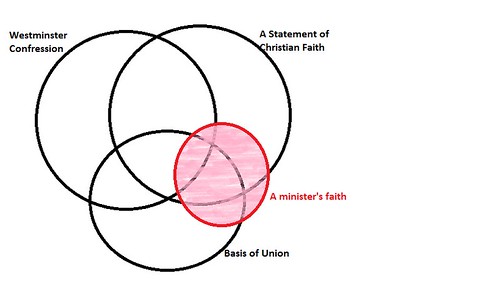 |
| URC approach to "Substantial Agreement" |
Yes I use the subordinate standards, they have been an important vehicle of my initiation into Reformed Theology, but I do not use them in a sort of lets try to believe twenty impossible things before breakfast style. I usually read them through quite quickly the first time, to try to get a feel of them, what is important and how they stand. Then and this is an ongoing process I turn to bits I see as significant and try and work out why. It maybe I disagree with them, in which case I need to work out why, or it might be a phrase gives me cause for reflection, time to look deeper at other understandings. So Subordinate standards are there to say where we have been, not to determine who we are. Remember "Those who cannot remember the past are condemned to repeat it" (George Sanayana) so we need methods of remembering where we have been and knowing why we have travelled to where we are.
Saturday, June 2, 2012
When two traditions collide
In 1972 the URC came into being and two denominational traditions collided. There are problems today that are caused not by the positions regarding wider traditions, these were both traditions dominated by the Reformed Tradition, but by the fact that the two traditions did not bother to find out how the other tradition worked, the Presbyterian assumed that with these sort of half toned Congregationalists they would find it easy to dominate, the Congregationalists assumed that they would continue doing things as they always did with a few adjustments for Presbyterians as they had done before. The Presbyterians assumed there was a meeting two dissenting traditions of which theirs was superior because it was articulated. The Congregationalists just assumed the way they did things was the way it was to be done noy because it was Congregational but because that was how it was.
The mistake was made in thinking that within English Congretationalism there was a named tradition that in some way is comparable to the Presbyterian tradition of the Presbyterian Church of England. This Presbyterian tradition is that of a clear dissenting tradition that stands against the mainstream. It says "We do this BECAUSE we are PRESBYTERIAN". It is clear and defined. English Congregationalism on the whole found no need for such a tradition. Indeed may have found problems with having it. Rather with respect to tradition it relates as a dominant discourse, the tradition has no name (or rarely is named) but is referenced by how "We do it".
I suspect that this has several roots. Firstly the obvious one, the tradition is not a single strand but a loosely woven rope of many strands that are not always compatible. It is true that the Reformed strand is the core one but there are plenty of other bits. It has to be seen as an grouping that specialises in bringing the disparate together. What is more with the Independent part, for most congregations "the tradition" is primarily the tradition of that congregation and only secondarily draws on the wider experience of other congregations and the wider church. When you talk about the wider context few members have any interest. Thus there is a need to have a way of talking and holding things together without setting people's backs up. Names tend to carry baggage with them, so it is convenient if their is no name for anyone to object to.
Secondly in England there was an indicator name change I suspect at the end of the nineteenth Century. Before that all Congregational churches tended to be called Independent and Congregational used only after then. Traditions are conservative by nature, I suspect that there is a strong streek of people who still think of themselves as going to the Independent Chapel despite this. To add to this the change seems to coincide with the NonConformist Ascendancy in Late Victorian times. There were places in England where Congregationalism was the dominant tradition, so naturally it took the dominant form.
The result is that former English Congregationalists are not concious of their Congregational heritage but they are secure in it, assuming it is the way things ought to be done by any rational person. They have not had a name and feel no need for a name. For them the question was how the Presbyterians will alter the way we do things. It is a tradition based around absorbing not fracturing.
The former Presbyterians, as do former Congregational Church of Scotland, (I have not idea what former Churches of Christ do) find that what happens is that instead of their nice named dissenting tradition, they are faced with a nameless mesh of ideas that somehow resists their attempts to say what it should be like. What is worse it uses the first person plural "We" of itself so your choice is to join it or dissent from belonging. This is not tradition as they know it, yet it assumes the dominant position.
The mistake was made in thinking that within English Congretationalism there was a named tradition that in some way is comparable to the Presbyterian tradition of the Presbyterian Church of England. This Presbyterian tradition is that of a clear dissenting tradition that stands against the mainstream. It says "We do this BECAUSE we are PRESBYTERIAN". It is clear and defined. English Congregationalism on the whole found no need for such a tradition. Indeed may have found problems with having it. Rather with respect to tradition it relates as a dominant discourse, the tradition has no name (or rarely is named) but is referenced by how "We do it".
I suspect that this has several roots. Firstly the obvious one, the tradition is not a single strand but a loosely woven rope of many strands that are not always compatible. It is true that the Reformed strand is the core one but there are plenty of other bits. It has to be seen as an grouping that specialises in bringing the disparate together. What is more with the Independent part, for most congregations "the tradition" is primarily the tradition of that congregation and only secondarily draws on the wider experience of other congregations and the wider church. When you talk about the wider context few members have any interest. Thus there is a need to have a way of talking and holding things together without setting people's backs up. Names tend to carry baggage with them, so it is convenient if their is no name for anyone to object to.
Secondly in England there was an indicator name change I suspect at the end of the nineteenth Century. Before that all Congregational churches tended to be called Independent and Congregational used only after then. Traditions are conservative by nature, I suspect that there is a strong streek of people who still think of themselves as going to the Independent Chapel despite this. To add to this the change seems to coincide with the NonConformist Ascendancy in Late Victorian times. There were places in England where Congregationalism was the dominant tradition, so naturally it took the dominant form.
The result is that former English Congregationalists are not concious of their Congregational heritage but they are secure in it, assuming it is the way things ought to be done by any rational person. They have not had a name and feel no need for a name. For them the question was how the Presbyterians will alter the way we do things. It is a tradition based around absorbing not fracturing.
The former Presbyterians, as do former Congregational Church of Scotland, (I have not idea what former Churches of Christ do) find that what happens is that instead of their nice named dissenting tradition, they are faced with a nameless mesh of ideas that somehow resists their attempts to say what it should be like. What is worse it uses the first person plural "We" of itself so your choice is to join it or dissent from belonging. This is not tradition as they know it, yet it assumes the dominant position.
Friday, June 1, 2012
Respect the Culture of the Internet
An incident still annoys me and it is probably ten years since it happened. I was studying Sociology and doing one of the how to courses, which had its bit on ethics and the need to anonymise. One guy did a bit on exploring internet culture and the thing that rankles is that he totally disregarded this advice, so much so I am sure I know and can get in touch with one of his informants.
He took a bit of conversation from a chat room. It was a short exchange between two people using nom de plumes. It looked to him as if people were using pen names and therefore he thought he did not need to anonymise. What is more the name was short and not a recognaisable name in any language. Surely this name was not a give-away. It is, it belongs to one specific person who has used it for the best part of twenty years or more. If I see that name anywhere on the internet I assume it is her who typed that. What is more the personna she portrays in the interaction is typical of her personna elsewhere where I do know her.
Lets go back to the beginning and to usenet boards and maybe even earlier. Names were limited, the maximum length was eight characters if you were lucky. So you could not have JohnSmith as your name. The challenge in those days was to find an eight letter code that was both memorable and not taken. Once found people tended to stick with it. In a very real sense they developed an ownership of that code. Towards the end of those days a six letters in a search engine would have got you most of my internet activity except work stuff (there it was five). Now you'd have to go down half a page to find something that relates to me as others use that code. However some have stuck with their name or code and some of those are very short.Therefore when people move from forum to forum you can look out for the same names and find the same people.
So despite what the social scientists like to think, the internet was never a lot of nameless geeks rampaging around having careless fun. The geeks from fairly early on established a culture that maintained identity across bulletin boards, message boards and discussion rooms. There was no policing except the more codes you used the more names and codes you had to do, sock puppetry (having multiple codes on a single discussion board, was looked down upon). In a stuation where discussion boards appeared and disappeared pretty frequently by doing so people often knew who they were talking to or at least knew what previous interaction they could recall.
Now with something like twenty years of being on the internet (alright so I was technically on one of its precursors in 1984 and I have very rarely been off since but using really started around 1992 with the present job). I can say that on the internet it is possible to fool everyone sometimes and some people all the time but it isn't possible to fool everyone all the time. It is simply too much effort for most people to keep two or more different consistent personas going. They normally make one of two mistakes:
So when you investigate social behaviour on the internet, please do not fall for the simplistic assumption that pen-names are anonymous. They may be or they may be the way that individual is most widely known.
He took a bit of conversation from a chat room. It was a short exchange between two people using nom de plumes. It looked to him as if people were using pen names and therefore he thought he did not need to anonymise. What is more the name was short and not a recognaisable name in any language. Surely this name was not a give-away. It is, it belongs to one specific person who has used it for the best part of twenty years or more. If I see that name anywhere on the internet I assume it is her who typed that. What is more the personna she portrays in the interaction is typical of her personna elsewhere where I do know her.
Lets go back to the beginning and to usenet boards and maybe even earlier. Names were limited, the maximum length was eight characters if you were lucky. So you could not have JohnSmith as your name. The challenge in those days was to find an eight letter code that was both memorable and not taken. Once found people tended to stick with it. In a very real sense they developed an ownership of that code. Towards the end of those days a six letters in a search engine would have got you most of my internet activity except work stuff (there it was five). Now you'd have to go down half a page to find something that relates to me as others use that code. However some have stuck with their name or code and some of those are very short.Therefore when people move from forum to forum you can look out for the same names and find the same people.
So despite what the social scientists like to think, the internet was never a lot of nameless geeks rampaging around having careless fun. The geeks from fairly early on established a culture that maintained identity across bulletin boards, message boards and discussion rooms. There was no policing except the more codes you used the more names and codes you had to do, sock puppetry (having multiple codes on a single discussion board, was looked down upon). In a stuation where discussion boards appeared and disappeared pretty frequently by doing so people often knew who they were talking to or at least knew what previous interaction they could recall.
Now with something like twenty years of being on the internet (alright so I was technically on one of its precursors in 1984 and I have very rarely been off since but using really started around 1992 with the present job). I can say that on the internet it is possible to fool everyone sometimes and some people all the time but it isn't possible to fool everyone all the time. It is simply too much effort for most people to keep two or more different consistent personas going. They normally make one of two mistakes:
- The actually create two very similar personnas, and then some adminy type does the checking on the logs and all are revealled
- The go for the spectacular, with heightened stories or crusading for a particular perspective (Kierkegaard the first internet troll?). These draw attention, almost certainly as much suspicious attention as any others. Such people are either unmasked or are asked to leave as they are causing problems.
So when you investigate social behaviour on the internet, please do not fall for the simplistic assumption that pen-names are anonymous. They may be or they may be the way that individual is most widely known.
Tuesday, April 3, 2012
Fair Fuel: fair to whom?
I am begining to wonder if some people understand what joined up thinking is. Low tax on fuel may not be a good idea and here is why:
- Oil is a limited resource, the consensus is that we are over dependent on it in the west and if the oil producing countries suddenly stop producing oil for some reason our own supplies are even more limited. We are an oil consuming; while not really an oil producing nation, Europe's supplies are due to run out in two years and I suspect most of those are in Eastern Europe. Some oil producing countries are very volatile politically. So long term oil will run out, short term we are rather dependent on friends where perhaps we would be wise not to be. So anything that means we should use less, being more cautious about what we use may be for our own long term health. What is more my Chemistry teacher argued that oil is such a valuable substance it should not just be burnt up and that goes back to 1980s. It seems to me it is pay now or pay more later.
- You have heard of global warming, the theory suggests that to some extent it is related to increase in carbon dioxide in the atmosphere. The bi-product of burning oil in a combustion engine is carbon dioxide which is put out into the atmosphere. Given the effects that can cause I suspect we should be trying to minimize rather than increase the risk for the sake of the whole planet.
- Finally we will talk about how high oil prices makes UK industry uncompetitive with other industry. Keeping oil prices relatively low in the developed world has often been a method of enabling UK industry to out compete local industry in third world countries, sometimes the need to do this had led to quite drastic situations such as Ogoniland Oil Spill


Saturday, March 24, 2012
From Fencing to Open Communion
This is the story of a piece of folk liturgy within the Reformed tradition that is so common that we don't even see it as there. It is nice because it is tidy story that covers Reformed tradition from start to current day and probably is most influential in creating the Ecumenical movement
The story starts off in Geneva with John Calvin. John Calvin in quite a dramatic way fenced the table from libertines. His document Treatise against the Anabaptist and Libertines does suggest some more moderation:
"That is, that none be so hardy to approach to this holy table, which is not verily of the body of Jesus Christ, worshiping one God with all faithful men, and serving him in good lawful vocation. But where they come to make declaration in their fourth Article, how a man ought to separate himself from all pollutions of the world to join himself to God: there they begin to deprave [turn out of the way] altogether"
Note that piety is indeed required but separation from all polution is not.
However in Scotland under Presbyterianism and fencing the table got out of hand. In the song Cameronian Cat you get the story of a cat found catching a mouse on the Sabbath day and the dire consequences it suffers. However under notes you get the following:
" It is by some called The Presbyterian Cat, but generally as above; and is always sung by the wags in mockery of the great pretended strictness of the Covenanters, which is certainly, in some cases, carried to an extremity rather ludicrous. I have heard them myself, when distributing the sacrament, formally debar from the table the king and all his ministers; all witches and warlocks; all who had committed or attempted suicide; all who played at cards and dice; all the men that had ever danced opposite to a woman, and every woman that had danced with her face toward a man; all the men who looked at their cattle or crops, and all the women who pulled green kail or scraped potatoes, on the Sabbath-day; and I have been told, that in former days they debarred all who used fanners for cleaning their oats, instead of God’s natural wind." (Hogg, JR I (1819), 37, Song #XXII, + music; note, p. 209)
From what had been a sensible practice had got as unsensible as the anabaptists practice that John Calvin wrote against.
Now let enter a Scottish Congregationalist of some liturgical skill, one John Hunter. Now Congregationalists in Scotland often struggled to find their position with respect to the strong Presbyterian culture. A Reformed church that was not Presbyterian in structure just seemed odd. Now Reformed churches did not do much beyond basic liturgy whether Congregational or Presbyterian but John Hunter takes the prohibitions that are used by the Presbyterians and changes them around in his address by the minister to the people.
"Ye that do truly and earnestly repent you of your sins and are in love and charity with your neighbours and intend to lead a new life, following the commandments of the God and walking henceforth in his holy ways; draw near with reverence, faith and thanksgiving, and take the Supper of the Lord to your comfort
Come to this sacred Table, not because you must, but because you may: come to testify not that you are righteous but that you sincerely love our Lord Jesus Christ and desire to be his true disciple: come not because you are strong but because you are weak; not because you have any claim on heaven's rewards, but because in your fraility and sin you stand in need of Heaven's mercy and help: come not to express opinion but to seek a Presence and pray for a Spirit
And now that the supper of the Lord is spread before you, lift up your minds and hearts above all selfish fears and cares; let this bread and this wine be to you the witnesses and signs of the grace of our Lord Jesus Christ, the love of God and the communion of the Holy Spirit, Before the throne of the Heavenly Father and the cross of the Redeemer make you humble confession of sin, consecrate you lives to Christian obedience and service and pray for strength to do and to bear the holy and blessed will of God"
It is no longer a list of who may not come, but an invite too come. Horton Davies describes it as "his greatest single liturgical invention" [Davies, H.(1962) Worship and Theology in England: From Newman to Martineau; Oxford University Press p232].
A invitation often paying service to this one, happens now in most if not all communion services. If you go back to the worship books you won't often find it, yet time after time in the actual act of worship. What is more is the invite asks people to come, more and more it has stressed that it is Christ's table not the table of any creed or sect (yes I am quoting but not sure where from).
The thing is that this repeated at people statement has entered the conciousness of the church going public. It has become part of how we think of ourselves. I have seen it quoted in theological debate as well as during worship. Most people's understanding of the rubrics of communion come from this and not from the dry rules that technically govern such things. If a congregation of whatever tradition has some sort of an open table, I suspect this working in the background. The genie is out of the bottle, the tables have become open, I suspect no-one can put it back however much any tradition tries to apply the rules. This all because a Scot's Congregationalist needed to find a way to differentiate his congregation from the Presbyterian around it!
The story starts off in Geneva with John Calvin. John Calvin in quite a dramatic way fenced the table from libertines. His document Treatise against the Anabaptist and Libertines does suggest some more moderation:
"That is, that none be so hardy to approach to this holy table, which is not verily of the body of Jesus Christ, worshiping one God with all faithful men, and serving him in good lawful vocation. But where they come to make declaration in their fourth Article, how a man ought to separate himself from all pollutions of the world to join himself to God: there they begin to deprave [turn out of the way] altogether"
Note that piety is indeed required but separation from all polution is not.
However in Scotland under Presbyterianism and fencing the table got out of hand. In the song Cameronian Cat you get the story of a cat found catching a mouse on the Sabbath day and the dire consequences it suffers. However under notes you get the following:
" It is by some called The Presbyterian Cat, but generally as above; and is always sung by the wags in mockery of the great pretended strictness of the Covenanters, which is certainly, in some cases, carried to an extremity rather ludicrous. I have heard them myself, when distributing the sacrament, formally debar from the table the king and all his ministers; all witches and warlocks; all who had committed or attempted suicide; all who played at cards and dice; all the men that had ever danced opposite to a woman, and every woman that had danced with her face toward a man; all the men who looked at their cattle or crops, and all the women who pulled green kail or scraped potatoes, on the Sabbath-day; and I have been told, that in former days they debarred all who used fanners for cleaning their oats, instead of God’s natural wind." (Hogg, JR I (1819), 37, Song #XXII, + music; note, p. 209)
From what had been a sensible practice had got as unsensible as the anabaptists practice that John Calvin wrote against.
Now let enter a Scottish Congregationalist of some liturgical skill, one John Hunter. Now Congregationalists in Scotland often struggled to find their position with respect to the strong Presbyterian culture. A Reformed church that was not Presbyterian in structure just seemed odd. Now Reformed churches did not do much beyond basic liturgy whether Congregational or Presbyterian but John Hunter takes the prohibitions that are used by the Presbyterians and changes them around in his address by the minister to the people.
"Ye that do truly and earnestly repent you of your sins and are in love and charity with your neighbours and intend to lead a new life, following the commandments of the God and walking henceforth in his holy ways; draw near with reverence, faith and thanksgiving, and take the Supper of the Lord to your comfort
Come to this sacred Table, not because you must, but because you may: come to testify not that you are righteous but that you sincerely love our Lord Jesus Christ and desire to be his true disciple: come not because you are strong but because you are weak; not because you have any claim on heaven's rewards, but because in your fraility and sin you stand in need of Heaven's mercy and help: come not to express opinion but to seek a Presence and pray for a Spirit
And now that the supper of the Lord is spread before you, lift up your minds and hearts above all selfish fears and cares; let this bread and this wine be to you the witnesses and signs of the grace of our Lord Jesus Christ, the love of God and the communion of the Holy Spirit, Before the throne of the Heavenly Father and the cross of the Redeemer make you humble confession of sin, consecrate you lives to Christian obedience and service and pray for strength to do and to bear the holy and blessed will of God"
It is no longer a list of who may not come, but an invite too come. Horton Davies describes it as "his greatest single liturgical invention" [Davies, H.(1962) Worship and Theology in England: From Newman to Martineau; Oxford University Press p232].
A invitation often paying service to this one, happens now in most if not all communion services. If you go back to the worship books you won't often find it, yet time after time in the actual act of worship. What is more is the invite asks people to come, more and more it has stressed that it is Christ's table not the table of any creed or sect (yes I am quoting but not sure where from).
The thing is that this repeated at people statement has entered the conciousness of the church going public. It has become part of how we think of ourselves. I have seen it quoted in theological debate as well as during worship. Most people's understanding of the rubrics of communion come from this and not from the dry rules that technically govern such things. If a congregation of whatever tradition has some sort of an open table, I suspect this working in the background. The genie is out of the bottle, the tables have become open, I suspect no-one can put it back however much any tradition tries to apply the rules. This all because a Scot's Congregationalist needed to find a way to differentiate his congregation from the Presbyterian around it!
Friday, February 10, 2012
What is holiness
In Leviticus 11:45 we read:
Generous - In some ways we need to come to terms with this. God's love is never sensible in its generosity. God does not seem to give us what we think as practical or even what we think we would like. God is frustratingly the sort of person who decides we need a diamond ring when what we were looking for was a good night out. God is capricious and overwhelming. There is not saying what he will do, but you equally can't be sure that he won't permit or do something. I don't know why, but I do know that if God's action on the cross is what Christians claim it is, then no amount of prayer not answered can balance the books. The problem is that God is does not seem to keep account and give fairly. Generosity in this sense is not about amount its about openness. So our response needs to have some of the lack of calculation that God's response to us does.
Faithful - There is as saying that goes "When the going gets tough, the tough get going" and that really is the core of being faithful. God has a habit of turning up in the darkest of places. He rescues Israel from Egypt not in Joseph's day, but when they were basically slave labour. He does not decide to come in person when things in Israel are going well and turns up at the palace, he comes when Israel is occupied and gets himself killed by the occupying authorities. Now lets be clear I don't trust God for one moment to get me out of trouble, he may, he may not; I do trust God to be there in times of trouble.
Love - forget romantic attraction, this seems to be more positive regard. Well wishing that is followed through into practical action.If you prefer unconditional regard for all of creation and all creatures with it. Another is that God enjoys creation, much as many men enjoy hobbies, the are serious about it, often quite nerdishly so and gain satisfaction from doing it. God does not need creation but it flows out of the very nature of God. That is important, God's love comes first. The challenge for the Christian is to mirror this sort of connection back at God and onto creation. As we do it towards creation we become co-creators with God, as we do it to God we honour and enjoy him.
For I am the LORD who brought you up out of the land of Egypt to be your God. You shall therefore be holy, for I am holy.”. This would not be problematic if it was not for 1 Peter 1:16 which quotes it. So at least one biblical writer thought it applied to Christians as well as Jews. But what does "Holy" mean. Initially it seems in context to have done with ritual purity but then Christians have a different understanding of what makes a person unclean see Matthew 15:11 and refers it to moral deeds done by a person. However I am going to suggest that we learn more about what being Holy entails if we see it as reflecting God. So what are the characteristics that seem to specifically define God as worshipped by Christians. I would suggest that chief amongst them is generous, faithful love.
Generous - In some ways we need to come to terms with this. God's love is never sensible in its generosity. God does not seem to give us what we think as practical or even what we think we would like. God is frustratingly the sort of person who decides we need a diamond ring when what we were looking for was a good night out. God is capricious and overwhelming. There is not saying what he will do, but you equally can't be sure that he won't permit or do something. I don't know why, but I do know that if God's action on the cross is what Christians claim it is, then no amount of prayer not answered can balance the books. The problem is that God is does not seem to keep account and give fairly. Generosity in this sense is not about amount its about openness. So our response needs to have some of the lack of calculation that God's response to us does.
Faithful - There is as saying that goes "When the going gets tough, the tough get going" and that really is the core of being faithful. God has a habit of turning up in the darkest of places. He rescues Israel from Egypt not in Joseph's day, but when they were basically slave labour. He does not decide to come in person when things in Israel are going well and turns up at the palace, he comes when Israel is occupied and gets himself killed by the occupying authorities. Now lets be clear I don't trust God for one moment to get me out of trouble, he may, he may not; I do trust God to be there in times of trouble.
Love - forget romantic attraction, this seems to be more positive regard. Well wishing that is followed through into practical action.If you prefer unconditional regard for all of creation and all creatures with it. Another is that God enjoys creation, much as many men enjoy hobbies, the are serious about it, often quite nerdishly so and gain satisfaction from doing it. God does not need creation but it flows out of the very nature of God. That is important, God's love comes first. The challenge for the Christian is to mirror this sort of connection back at God and onto creation. As we do it towards creation we become co-creators with God, as we do it to God we honour and enjoy him.
Monday, December 19, 2011
Christmas thoughts from visits to my hairdresser
I have been to have a haircut today and for the second time on the trot my hairdresser and I got talking about Christmas. No not the "What are you doing at Christmas talk", well we did briefly, but as she is off to Australia just after and I am just doing the usual it is neither of ours hot topic of conversation.
No what we have been talking is about excess that surrounds Christmas. Last time it was the commercials asking people to go into debt in order to get people the right present. Yes that is right, there are commercials that advertise going into debt as a positive solution! It seemed over the top to me and to her.
Today the topic was on excess drinking. A student has been knocked down and seriously injured after a "Christmas Day" event at the Students Union. You can check it out at Sheffield if you prefer but that reporting is far more sensible in my opinion than what is available at Sheffield. The quotations marks around "Christmas Day" are deliberate since it was held on 15th December and secondly its main attraction seemed to be cut price drinks. The carol service happened on 14th for instance and I did not hear of anywhere serving turkey sandwiches cheap. Is Christmas really seen by those student age as really being about getting drunk, probably very drunk?
It makes you wonder if all our festivities at this time of year are well and truly fucked up. Maybe we would be better off in a world where the story did not end with Scrooges conversion to the Christmas Spirit and we all had to be in work on Christmas day. Maybe we could do with having to get a certificate from our cleric to say that we were active Christians in order to have Christmas day off as a religious festival. I wonder if church attendance would go up if that was the case. Give any religion three days a year, to be specified by the authority of the group (maybe we would have to specify three for atheists: maybe Human Rights Day, Workers Day and Earth Day as they don't seem to require any religious attachment. If you want other days, than those, you have to find you religious person to certify you as practising whatever belief. It would mean the withdrawal of Christmas Day, Good Friday and Easter Monday as general bank holidays. Maybe Boxing day could be attached to New Year as in Scotland.
It sounds good in principle but I just expect the excess would be spread over to New Year.
Now I am also sure the Students Union was playing to what attracts students. Cheap alcohol has long been a tool for attracting students to use the Union and I am pretty sure that if the Union lost its license it would pretty quickly be in financial difficulties despite the money the University puts in and its other enterprises. I am pretty sure as well that the encouragement to go into further debt was because in part the economy runs on debt. We have become dependent on people behaving excessively to survive as a culture. I want to suggest our culture is sick.
I tell you we have lost two things is desire and appreciation. What we have is gratification. The thing is that without desire, gratification looses it savour. Desire is the practice of developing a want, of understanding the wanting in itself to be good and a proper preparation for gratification. It is about imagining what we want, thinking it through, planning for it, finding the money, denying ourselves other things so we are ready for it. This sort of practice does not diminish the gratification but increases it and can itself be pleasurable.
Appreciation is the mirror image of desire, it comes after the gratification, when you appreciate what is given not because it means a want but for what it is. It is the looking back and enjoying memories (try doing that after a night when you are blind drunk), it is knowing not that you got anything for your desire but you chose the right one and it is the feeling of no longer having to do without. Instant gratification never gives you the sense of something truly desired being gratified, you never fully appreciate the part it plays in your life unless you have truly experienced being without it. It is savouring the flavours in the drink not just knocking it back for the fussy feelings it gives you. It is about caring for something, looking after it, because it is desired even though you have it.
No what we have been talking is about excess that surrounds Christmas. Last time it was the commercials asking people to go into debt in order to get people the right present. Yes that is right, there are commercials that advertise going into debt as a positive solution! It seemed over the top to me and to her.
Today the topic was on excess drinking. A student has been knocked down and seriously injured after a "Christmas Day" event at the Students Union. You can check it out at Sheffield if you prefer but that reporting is far more sensible in my opinion than what is available at Sheffield. The quotations marks around "Christmas Day" are deliberate since it was held on 15th December and secondly its main attraction seemed to be cut price drinks. The carol service happened on 14th for instance and I did not hear of anywhere serving turkey sandwiches cheap. Is Christmas really seen by those student age as really being about getting drunk, probably very drunk?
It makes you wonder if all our festivities at this time of year are well and truly fucked up. Maybe we would be better off in a world where the story did not end with Scrooges conversion to the Christmas Spirit and we all had to be in work on Christmas day. Maybe we could do with having to get a certificate from our cleric to say that we were active Christians in order to have Christmas day off as a religious festival. I wonder if church attendance would go up if that was the case. Give any religion three days a year, to be specified by the authority of the group (maybe we would have to specify three for atheists: maybe Human Rights Day, Workers Day and Earth Day as they don't seem to require any religious attachment. If you want other days, than those, you have to find you religious person to certify you as practising whatever belief. It would mean the withdrawal of Christmas Day, Good Friday and Easter Monday as general bank holidays. Maybe Boxing day could be attached to New Year as in Scotland.
It sounds good in principle but I just expect the excess would be spread over to New Year.
Now I am also sure the Students Union was playing to what attracts students. Cheap alcohol has long been a tool for attracting students to use the Union and I am pretty sure that if the Union lost its license it would pretty quickly be in financial difficulties despite the money the University puts in and its other enterprises. I am pretty sure as well that the encouragement to go into further debt was because in part the economy runs on debt. We have become dependent on people behaving excessively to survive as a culture. I want to suggest our culture is sick.
I tell you we have lost two things is desire and appreciation. What we have is gratification. The thing is that without desire, gratification looses it savour. Desire is the practice of developing a want, of understanding the wanting in itself to be good and a proper preparation for gratification. It is about imagining what we want, thinking it through, planning for it, finding the money, denying ourselves other things so we are ready for it. This sort of practice does not diminish the gratification but increases it and can itself be pleasurable.
Appreciation is the mirror image of desire, it comes after the gratification, when you appreciate what is given not because it means a want but for what it is. It is the looking back and enjoying memories (try doing that after a night when you are blind drunk), it is knowing not that you got anything for your desire but you chose the right one and it is the feeling of no longer having to do without. Instant gratification never gives you the sense of something truly desired being gratified, you never fully appreciate the part it plays in your life unless you have truly experienced being without it. It is savouring the flavours in the drink not just knocking it back for the fussy feelings it gives you. It is about caring for something, looking after it, because it is desired even though you have it.
Monday, November 21, 2011
A Radical Welcome Eh?
The United Reformed Church has decided to run an evangelistic advertising campaign called Radical Welcome. Now I can argue that it is a good thing on a number of issues, and I can also here the arguments about it being wrong on a whole lot of other issues but that is not the point of this posting. It has two names really the one used "Radical Welcome" which seems fairly popular with people at present and the less popular one that the campaign agency prefers of "Zero Intolerance". Lots of people are attacking "Zero Intolerance" as a title I however want to make clear that "Radical Welcome" is not without its problems.
The problem isn't with the word "Radical" its the word "Welcome". What is a welcome? Is it the ability to enter a church building without hindrance and to be physically safe while in there? Is it the strength of the hand shake on the door? Is it the depths of the fellowship?
Most URCs are actually pretty good at the first two although and I hope disability campaigners will take note, we tend when it comes to disability to form fill until we are confronted with someone who is. So at my local congregation we had braille hymnbooks but until we were faced with a person who used them we did not wonder about getting a table to put them on. The number of loop systems that are not properly working until someone who is deaf and understands these things comes along, is appalling. I can still remember one guys face when a friend made the effort to get a loop system working at a church that had one that wasn't and he heard the sermon for the first time in years. He was beaming from ear to ear. My view on disability is that all congregations should advertise someone as the person to contact, and they should be prepared to meet with a disabled person and/or their carer and discuss requirements before the person is faced with coming into worship on a Sunday. This person should normally not be clergy.
The warm handshake and the brief chat is clearly catered for in most URCs. I mean that seriously, here is the description of the welcome given at the first Mystery Worshipper Report I found today on Ship of Fools
"The welcome was amazing. I was greeted at the front entrance by a couple, who both shook my hand. Then, as I entered the church, three other people welcome me. I received the relevant service sheet, Bible and hymn book. One of them introduced herself as Eunice, the church secretary. I sat down near the middle of the church, and three more people came up to me, one by one, to say hello and welcome. The minister also came over and introduced herself. They even showed me where the coffee hatch was, although it wouldn't be open until after the service."
Most URC reports are in that style. As far as initial welcome is concerned we largely have it sussed.
What is more most URCs have had it drummed into them that they must be welcoming, it really has been dinned in in the last twenty years. However apart from the tick box approach to equal access and the initial welcome, most members of the congregation judge a church to be welcoming by the warmth of the fellowship they experience.
The problem is that very cliquey churches where nobody could possibly join are also often places of very warm fellowship for those that belong to the clique. In such congregations the switch from "I am welcomed" to "We are welcoming" happens unnoticed. However this is poor evidence. Are they equally welcoming to the parents of the child with Aspbergers who can't sit quiet during the service? Are they as welcoming to the person who is twenty years younger than they are or do they think "he will be off very quickly to join a church where there are more young member and modern music". That sort of thought can become a self fulfilling prophecy and when the next person comes in in that age bracket then there is even less reason to be welcoming as "she will be off like the rest". Or what about the person who nips out between worship and coffee to have a cigarette? The person who comes in tatty clothes or smells? Yes we greet them at the door but hold a conversation with them when our friends are around?
No I am not being pious, I know I am as guilty as the rest of doing this, it is always easier to talk to people we know than to those we don't. I still have to make myself do it. It is also easier to talk to people we think of like us. It is far easier for many churches to accept a middle class gay couple in a long term relationship, than to accept the young married couple with a group of noisy children who use colourful language in discipling them.
What is more, if I only deal with people I know, then to some extent I am dealing with a known quantity, I like the familiar. The incorporation of somebody new into the community does not just mean change for them, it means change for us, and what is more unpredictable change. It takes real discipline to try and implement a consistent interest in people who are on the edge of your friendship group whether congregation or other. Even if you start from the supposition that variety makes for richness there is still the day when richness isn't what you want, or the a friends has pressing needs.
That means we need to look further into our hearts that we think. The welcome we really needs to have, is about meeting the person as that person. Not giving them a hand shake at the door then ignoring them, not ask them through to coffee the first week then expecting them to mix with their own friends from then on and leave us to talk to ours. It is also the real challenge of realising that some of them has a profound ability by our standards to mess things up and still managing to care for them without saying it is fine to mess things up. It is also the ability to see the love and care that so many of them demonstrate despite the mess they are in.
Communities that attempt to do that, I believe are struggling to become Christ like, but that isn't the work of five minutes, the human capacity to mess it up is huge. All I hope is by my death I have learnt slightly more of how to do that than I do now, I can only learn that from trying to participate in such communities not from all the theory books. This sort of knowledge is heart knowledge and the head can be totally sorted and the heart in totally the wrong place.
There is a problem though, the URC has consistently told its congregations that they must be more welcoming. The congregations have responded, they have developed a good initial welcome and dealt with a lot of discrimination issues. Members also find the local fellowship welcoming particularly if it has familiar faces that you see week in week out. So when they are asked to be welcoming they tick the box. Few, very few are going to admit there is something missing and those that do, know they are unwelcome for saying so.
The problem is that we need a conversion, that is us in the church need it, not those outside, and I worry that with all this talk of welcome we might just miss how radical the real task is.
The problem isn't with the word "Radical" its the word "Welcome". What is a welcome? Is it the ability to enter a church building without hindrance and to be physically safe while in there? Is it the strength of the hand shake on the door? Is it the depths of the fellowship?
Most URCs are actually pretty good at the first two although and I hope disability campaigners will take note, we tend when it comes to disability to form fill until we are confronted with someone who is. So at my local congregation we had braille hymnbooks but until we were faced with a person who used them we did not wonder about getting a table to put them on. The number of loop systems that are not properly working until someone who is deaf and understands these things comes along, is appalling. I can still remember one guys face when a friend made the effort to get a loop system working at a church that had one that wasn't and he heard the sermon for the first time in years. He was beaming from ear to ear. My view on disability is that all congregations should advertise someone as the person to contact, and they should be prepared to meet with a disabled person and/or their carer and discuss requirements before the person is faced with coming into worship on a Sunday. This person should normally not be clergy.
The warm handshake and the brief chat is clearly catered for in most URCs. I mean that seriously, here is the description of the welcome given at the first Mystery Worshipper Report I found today on Ship of Fools
"The welcome was amazing. I was greeted at the front entrance by a couple, who both shook my hand. Then, as I entered the church, three other people welcome me. I received the relevant service sheet, Bible and hymn book. One of them introduced herself as Eunice, the church secretary. I sat down near the middle of the church, and three more people came up to me, one by one, to say hello and welcome. The minister also came over and introduced herself. They even showed me where the coffee hatch was, although it wouldn't be open until after the service."
Most URC reports are in that style. As far as initial welcome is concerned we largely have it sussed.
What is more most URCs have had it drummed into them that they must be welcoming, it really has been dinned in in the last twenty years. However apart from the tick box approach to equal access and the initial welcome, most members of the congregation judge a church to be welcoming by the warmth of the fellowship they experience.
The problem is that very cliquey churches where nobody could possibly join are also often places of very warm fellowship for those that belong to the clique. In such congregations the switch from "I am welcomed" to "We are welcoming" happens unnoticed. However this is poor evidence. Are they equally welcoming to the parents of the child with Aspbergers who can't sit quiet during the service? Are they as welcoming to the person who is twenty years younger than they are or do they think "he will be off very quickly to join a church where there are more young member and modern music". That sort of thought can become a self fulfilling prophecy and when the next person comes in in that age bracket then there is even less reason to be welcoming as "she will be off like the rest". Or what about the person who nips out between worship and coffee to have a cigarette? The person who comes in tatty clothes or smells? Yes we greet them at the door but hold a conversation with them when our friends are around?
No I am not being pious, I know I am as guilty as the rest of doing this, it is always easier to talk to people we know than to those we don't. I still have to make myself do it. It is also easier to talk to people we think of like us. It is far easier for many churches to accept a middle class gay couple in a long term relationship, than to accept the young married couple with a group of noisy children who use colourful language in discipling them.
What is more, if I only deal with people I know, then to some extent I am dealing with a known quantity, I like the familiar. The incorporation of somebody new into the community does not just mean change for them, it means change for us, and what is more unpredictable change. It takes real discipline to try and implement a consistent interest in people who are on the edge of your friendship group whether congregation or other. Even if you start from the supposition that variety makes for richness there is still the day when richness isn't what you want, or the a friends has pressing needs.
That means we need to look further into our hearts that we think. The welcome we really needs to have, is about meeting the person as that person. Not giving them a hand shake at the door then ignoring them, not ask them through to coffee the first week then expecting them to mix with their own friends from then on and leave us to talk to ours. It is also the real challenge of realising that some of them has a profound ability by our standards to mess things up and still managing to care for them without saying it is fine to mess things up. It is also the ability to see the love and care that so many of them demonstrate despite the mess they are in.
Communities that attempt to do that, I believe are struggling to become Christ like, but that isn't the work of five minutes, the human capacity to mess it up is huge. All I hope is by my death I have learnt slightly more of how to do that than I do now, I can only learn that from trying to participate in such communities not from all the theory books. This sort of knowledge is heart knowledge and the head can be totally sorted and the heart in totally the wrong place.
There is a problem though, the URC has consistently told its congregations that they must be more welcoming. The congregations have responded, they have developed a good initial welcome and dealt with a lot of discrimination issues. Members also find the local fellowship welcoming particularly if it has familiar faces that you see week in week out. So when they are asked to be welcoming they tick the box. Few, very few are going to admit there is something missing and those that do, know they are unwelcome for saying so.
The problem is that we need a conversion, that is us in the church need it, not those outside, and I worry that with all this talk of welcome we might just miss how radical the real task is.
Friday, September 30, 2011
From where does good self image come?
I am on holiday staying with close friends, last Sunday morning my friend applied for a job working with alcohol and drug abusers. Her reason for taking it rather than staying with a current job was partly pay, although it is even shorter term than her current one, partly status as it is 'proper' social work although it is no more secure than her current job (both have short term contracts) and that means that her clients have to see her.
I challenged her on this, my dealings with addicts suggest that it takes lots of self discipline to stay off what you are addicted to. That it is a niggle that wears away at a person. She then made the comment that for most addicts accessing services meant they had to acknowledge their addiction and to do this was to undermine their already poor self esteem. This is wronger than a wrong thing that is mistaken (Erin:Ship-of-fools).
The thing is there are two things that build real self esteem in my book and the first has to come first. According to Jurgen Wolff, Brian Tracy when stuck in the desert with a friends and a broken down landrover, faced the first. That is if life is to be worthwhile, it is up to us to take responsibility for what is going on in it at the moment. Not seek to blame but in the same way a treasurer is responsible for a clubs money. Circumstances can be someone-else's fault and nearly always we are co-creators of them with others, but on the whole the finding of blame is pretty pointless. Rather the question that is useful is "What am I going to do about it?" Doing something to try and improve the situation, in Brian Tracy's case help fix the Landrover, is the crucial step. It changes one from victim to active player. There is no guarantee of success but you have made failure less likely.
It is recorded that most addicts don't believe they are addicted. They believe they can give it up at any time and because they never try they never fail at that! The fact that the addiction is controlling more and more of their lives is not taken into consideration. They will justify doing it, even telling themselves lies. I have seen it, it is not pretty. Keeping the addiction going becomes a method to avoid dealing with other things. It eventually becomes the overarching organising principle of their lives and in doing so it saps their self esteem. Until someone in this situation faces up to the fact that they are responsible for their lives including their addiction nothing will change. So much as my friend may like to spare them that step until they do, there is no future and there will be no growth in self esteem.
The second part is altogether pleasanter and that is to find a non-judgemental accountable community. This is difficult, I suspect that for at least the first few years the person needs daily contact with the community. That is asking a lot of any group of people. It certainly isn't a one off thing. I suspect that it is not accidental that where such communities have existed they have had religious overtones (from Alcoholics Anonymous "higher power" to Evangelical Christian missions in Russia). The real good news as far as alcoholics go, is that when they are going sober, they often are some of the best and most skilled people at doing this. I do not know whether this is the case for drug users. I do know that other groups such as writers groups and so forth can form a similar function for parts of a persons life.
I suspect that for a few individuals of exceptional character the second may not be necessary, but it certainly eases the struggle. Unfortunately if the second happens without the first you can well end up supporting someone's self delusion. If that is addiction that could well make the situation worse.
Please note I am not saying addiction is solely a self-esteem issue, it isn't. It has many other facets, not least of which is craving, which is almost certainly due to brain chemistry and is very unlike other desires in that it is very close to compulsive.
I challenged her on this, my dealings with addicts suggest that it takes lots of self discipline to stay off what you are addicted to. That it is a niggle that wears away at a person. She then made the comment that for most addicts accessing services meant they had to acknowledge their addiction and to do this was to undermine their already poor self esteem. This is wronger than a wrong thing that is mistaken (Erin:Ship-of-fools).
The thing is there are two things that build real self esteem in my book and the first has to come first. According to Jurgen Wolff, Brian Tracy when stuck in the desert with a friends and a broken down landrover, faced the first. That is if life is to be worthwhile, it is up to us to take responsibility for what is going on in it at the moment. Not seek to blame but in the same way a treasurer is responsible for a clubs money. Circumstances can be someone-else's fault and nearly always we are co-creators of them with others, but on the whole the finding of blame is pretty pointless. Rather the question that is useful is "What am I going to do about it?" Doing something to try and improve the situation, in Brian Tracy's case help fix the Landrover, is the crucial step. It changes one from victim to active player. There is no guarantee of success but you have made failure less likely.
It is recorded that most addicts don't believe they are addicted. They believe they can give it up at any time and because they never try they never fail at that! The fact that the addiction is controlling more and more of their lives is not taken into consideration. They will justify doing it, even telling themselves lies. I have seen it, it is not pretty. Keeping the addiction going becomes a method to avoid dealing with other things. It eventually becomes the overarching organising principle of their lives and in doing so it saps their self esteem. Until someone in this situation faces up to the fact that they are responsible for their lives including their addiction nothing will change. So much as my friend may like to spare them that step until they do, there is no future and there will be no growth in self esteem.
The second part is altogether pleasanter and that is to find a non-judgemental accountable community. This is difficult, I suspect that for at least the first few years the person needs daily contact with the community. That is asking a lot of any group of people. It certainly isn't a one off thing. I suspect that it is not accidental that where such communities have existed they have had religious overtones (from Alcoholics Anonymous "higher power" to Evangelical Christian missions in Russia). The real good news as far as alcoholics go, is that when they are going sober, they often are some of the best and most skilled people at doing this. I do not know whether this is the case for drug users. I do know that other groups such as writers groups and so forth can form a similar function for parts of a persons life.
I suspect that for a few individuals of exceptional character the second may not be necessary, but it certainly eases the struggle. Unfortunately if the second happens without the first you can well end up supporting someone's self delusion. If that is addiction that could well make the situation worse.
Please note I am not saying addiction is solely a self-esteem issue, it isn't. It has many other facets, not least of which is craving, which is almost certainly due to brain chemistry and is very unlike other desires in that it is very close to compulsive.
Thursday, September 8, 2011
Mission in Urban Priority Areas (personal reflection)
I am tired after a hard week in work, it has been frustrating checking the fine details of papers to be submitted to journals and by 5:30 p.m. I am exhausted. All I really want to do is go home to my warm flat and relax with a glass of wine and a book but I need to shop for the weekend still, so that I can spend tomorrow working on my thesis.
So I set out and head to the supermarket. In doing so I walk down a major road, with ice still on the pavement from the snowfall about a week ago, past a few equally weary workers who trudge up the hill to where they live. By doing this I walk through a small area of with quite a high level of social deprivation. However although there are lights on in my home church, I see people come out of car park carrying large black cases which have the outline of brass instruments. there is Samba drums coming from the local community centre, but when passing the high-rise flats not a single creature stirs, not even the overfed pigeons. Nearby is the old Methodist Church that the Jesus Army have taken over and are redeveloping as a Jesus Centre.
On the underpass to the supermarket sits Mike, he has his battered blue parker hunched around his thin body, his black eyes sharp in his thin face, and before him sits his cap, waiting for any spare change the straggling passers by might put in. I stop and ask if he is getting on and if he wants anything to eat. In doing so I learn he is seven quid short of his B&B money for the night having 'slept' rough the previous night.
As I go to buy him his egg sandwich and a chocolate milk shake I ponder what to do. It is clear to me that tonight of all nights nobody should be sleeping rough. I am not sure that ringing emergency accommodation has any point even if I knew the number, which I don't. I know Mike is in contact with the authorities at least for the last six months. I also have never seen him clearly drunk or under the influence, I know he is ex-services and he smokes. I also know that most of the places I could send him during the day (or better still go with him to) are shut. In the end I give him the £7, he offers to repay, I reject saying that he should do something for himself with any extra.
It takes another eight months, a trip to hospital with serious illness before Mike is housed. His first plan on being housed was to go and help at local charity. Now I know I did not fix anything, I maybe gave Mike a bit more comfortable existence for twenty four hours but that is it. I may even have allowed him to get drugs that were the cause of his homelessness in the first place. I don't know. I do know that one of the problems of trying to help people like Mike, and there are plenty, different stories but similar difficult circumstances, is the fact that they live chaotic lives.
Expect them at church dressed in clean clothes at 11:00 a.m. on Sunday, and then to behave politely is just not reasonable. I am afraid the chance of getting them to a church is negligible. Mike was invited at least three or four times including people willing to walk in with him, to a community breakfast at my church less than half a mile away, he never came let alone to Sunday worship with many middle class people.
The problem is that in many ways church has to be twenty-four seven in these communities, it is no good expecting them to come when church is open, church needs to be open when they come. What is more they often need more support and effort at least initially than your average middle class person. In order to even start to comprehend the faith they will need a small affirmative accounting community. A place where they are helped to tackle the chaotic forces that rule their lives.
Yet I know equally the high cost of trying to do such work. I have lost count/track of the cases of burn out when people have tried. These were people of faith, why else would they do it. Even to live your life in close proximity to these people (by that I do not live in the area, I have done that for years and it can be done with very little contact, but actually living so you shop at their shops, socialise where they socialise) is extremely draining work.You are faced with an overwhelming need that could drain your spirit and your finances very single day.
I have come too a conclusion that really only two groups have the ability to deal with such a challenge. On the one hand there are the Roman Catholic orders who specialise in living alongside the marginalised. They manage to do it, partly because they have systems that watch peoples reserves, because quite often the brothers and sisters who do this have as much money as those they help (i.e. none) and because you normally do this as a community.
The second group are from the other end of the spectrum and are groups like the Jesus Army, again the do it by living in community, actually by quite strong discipleship and again by having a communal rather than an individual purse. The difference is that people from the area can join the Jesus Army where as the Roman Catholic brothers and sisters would expect people to join the local RC church and are not looking for others to have a vocation to their order. In some ways this makes the Jesus Army more vulnerable to the stresses of the people around them.
Which of the two is best?
Well the Roman Catholic has the advantage of not expecting people who want to be involved locally to make the commitment the brothers and sisters have made. The supply of people for the presence is not from the locality and what they want is to create a worshipping community around them that will be part of the Roman Catholic Church. The problem is that as soon as you start to help people in these very dire circumstances in a way that really does challenge the chaos, then they normally start rising up the social ladder and quite often end up moving out of the area. So you have an continual mission situation with the need for constant support.
With the Jesus Army approach you actually do develop a local community. There are people from the neighbourhood and they tend to stay because the amount they have invested in the Jesus Army, i.e. housing, job and friendship means that leaving is very difficult. What should the Jesus Army do for people who want to leave. They may well have come in with nothing, been given shelter and then experience of employment by the Jesus Army. If that person leaves and the Jesus Army gives them nothing then that person is destitute again and open to fresh forces of chaos. However given the amount of support the Jesus Army gives such people why should it be expected to support them still when they no longer want to belong?
It seems to me both are flawed but both work better in these circumstances than standard church model as practised by many churches in this country. Getting the balance right, for there to be a church which really is open to the community will always be extremely tough.
So I set out and head to the supermarket. In doing so I walk down a major road, with ice still on the pavement from the snowfall about a week ago, past a few equally weary workers who trudge up the hill to where they live. By doing this I walk through a small area of with quite a high level of social deprivation. However although there are lights on in my home church, I see people come out of car park carrying large black cases which have the outline of brass instruments. there is Samba drums coming from the local community centre, but when passing the high-rise flats not a single creature stirs, not even the overfed pigeons. Nearby is the old Methodist Church that the Jesus Army have taken over and are redeveloping as a Jesus Centre.
On the underpass to the supermarket sits Mike, he has his battered blue parker hunched around his thin body, his black eyes sharp in his thin face, and before him sits his cap, waiting for any spare change the straggling passers by might put in. I stop and ask if he is getting on and if he wants anything to eat. In doing so I learn he is seven quid short of his B&B money for the night having 'slept' rough the previous night.
As I go to buy him his egg sandwich and a chocolate milk shake I ponder what to do. It is clear to me that tonight of all nights nobody should be sleeping rough. I am not sure that ringing emergency accommodation has any point even if I knew the number, which I don't. I know Mike is in contact with the authorities at least for the last six months. I also have never seen him clearly drunk or under the influence, I know he is ex-services and he smokes. I also know that most of the places I could send him during the day (or better still go with him to) are shut. In the end I give him the £7, he offers to repay, I reject saying that he should do something for himself with any extra.
It takes another eight months, a trip to hospital with serious illness before Mike is housed. His first plan on being housed was to go and help at local charity. Now I know I did not fix anything, I maybe gave Mike a bit more comfortable existence for twenty four hours but that is it. I may even have allowed him to get drugs that were the cause of his homelessness in the first place. I don't know. I do know that one of the problems of trying to help people like Mike, and there are plenty, different stories but similar difficult circumstances, is the fact that they live chaotic lives.
Expect them at church dressed in clean clothes at 11:00 a.m. on Sunday, and then to behave politely is just not reasonable. I am afraid the chance of getting them to a church is negligible. Mike was invited at least three or four times including people willing to walk in with him, to a community breakfast at my church less than half a mile away, he never came let alone to Sunday worship with many middle class people.
The problem is that in many ways church has to be twenty-four seven in these communities, it is no good expecting them to come when church is open, church needs to be open when they come. What is more they often need more support and effort at least initially than your average middle class person. In order to even start to comprehend the faith they will need a small affirmative accounting community. A place where they are helped to tackle the chaotic forces that rule their lives.
Yet I know equally the high cost of trying to do such work. I have lost count/track of the cases of burn out when people have tried. These were people of faith, why else would they do it. Even to live your life in close proximity to these people (by that I do not live in the area, I have done that for years and it can be done with very little contact, but actually living so you shop at their shops, socialise where they socialise) is extremely draining work.You are faced with an overwhelming need that could drain your spirit and your finances very single day.
I have come too a conclusion that really only two groups have the ability to deal with such a challenge. On the one hand there are the Roman Catholic orders who specialise in living alongside the marginalised. They manage to do it, partly because they have systems that watch peoples reserves, because quite often the brothers and sisters who do this have as much money as those they help (i.e. none) and because you normally do this as a community.
The second group are from the other end of the spectrum and are groups like the Jesus Army, again the do it by living in community, actually by quite strong discipleship and again by having a communal rather than an individual purse. The difference is that people from the area can join the Jesus Army where as the Roman Catholic brothers and sisters would expect people to join the local RC church and are not looking for others to have a vocation to their order. In some ways this makes the Jesus Army more vulnerable to the stresses of the people around them.
Which of the two is best?
Well the Roman Catholic has the advantage of not expecting people who want to be involved locally to make the commitment the brothers and sisters have made. The supply of people for the presence is not from the locality and what they want is to create a worshipping community around them that will be part of the Roman Catholic Church. The problem is that as soon as you start to help people in these very dire circumstances in a way that really does challenge the chaos, then they normally start rising up the social ladder and quite often end up moving out of the area. So you have an continual mission situation with the need for constant support.
With the Jesus Army approach you actually do develop a local community. There are people from the neighbourhood and they tend to stay because the amount they have invested in the Jesus Army, i.e. housing, job and friendship means that leaving is very difficult. What should the Jesus Army do for people who want to leave. They may well have come in with nothing, been given shelter and then experience of employment by the Jesus Army. If that person leaves and the Jesus Army gives them nothing then that person is destitute again and open to fresh forces of chaos. However given the amount of support the Jesus Army gives such people why should it be expected to support them still when they no longer want to belong?
It seems to me both are flawed but both work better in these circumstances than standard church model as practised by many churches in this country. Getting the balance right, for there to be a church which really is open to the community will always be extremely tough.
Subscribe to:
Posts (Atom)